
9-min read
Aerodynamics in Vehicle Development: How Early Engineering Influences Efficiency, Driving Range, and Development Effort
KEY TAKEAWAYS:
• Aerodynamics plays an essential role in vehicle engineering during early development phases.
• Beyond aerodynamic drag, aerodynamics influences cooling, vehicle dynamics, lift, and soiling.
• Early development steps largely define the framework for later optimization.
• Simulation and physical wind tunnel testing work together across several development stages.
• Early alignment between design, architecture, and aerodynamics reduces later iterations and conflicting objectives.
• A robust development process is created through systematic integration and early validation.
WHY AERODYNAMICS IS PARTICULARLY RELEVANT TODAY
Aerodynamics has always been a central part of vehicle development. Its influence ranges from aerodynamic drag and vehicle dynamics to powertrain and component cooling, as well as soiling. The full scope of vehicle aerodynamics is reflected in its impact on Efficiency & Performance, Thermal Management, Comfort, Vehicle Dynamics & Stability, Aerodynamic Loads, and Visibility & Sensor Performance.
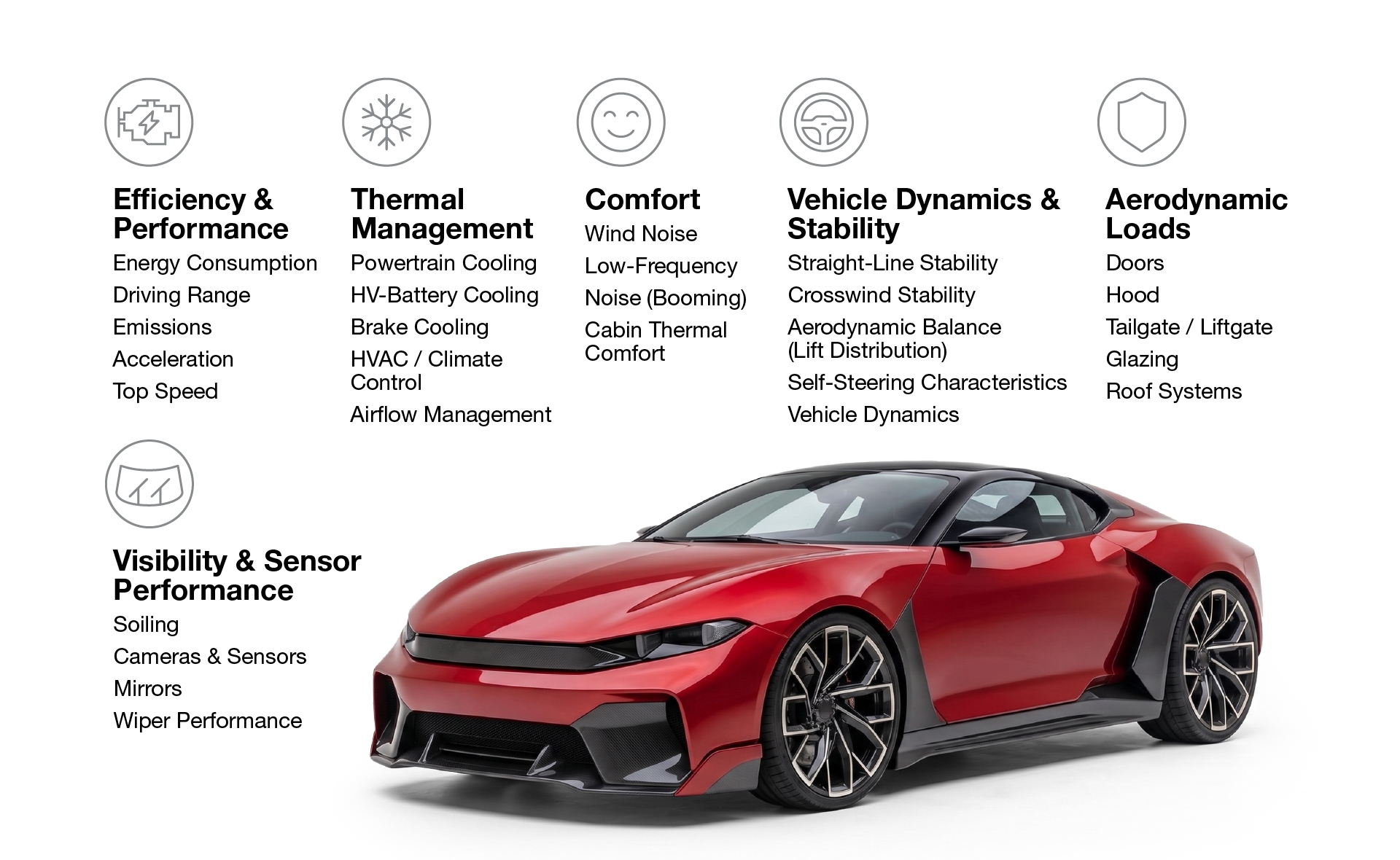
Figure 1: Influence of aerodynamics on complete vehicle performance, own illustration
Aerodynamics therefore does not affect individual performance values in isolation. It influences a wide range of functions and interactions across the complete vehicle. This makes aerodynamics not only a key factor in sustainable vehicle development, but also an essential part of vehicle engineering during early development phases.
With electrification, however, the conditions under which these tasks are addressed are changing. In battery electric vehicles, aerodynamics has a direct effect on driving range. At the same time, the cost and weight of the high-voltage battery are becoming more important because every efficiency improvement in the vehicle concept helps reduce energy demand and, consequently, battery requirements.
A simple example calculation based on the WLTP cycle for a large European premium SUV illustrates the scale of this leverage. A 30 percent reduction in the drag coefficient over the course of the project can reduce the energy consumption of an electric vehicle by around 14 percent and that of a vehicle with an internal combustion engine by around 11 percent. At the same time, aerodynamics can influence approximately one third of total energy consumption.

THE GREATEST LEVERAGE LIES IN THE FEASIBILITY AND EARLY CONCEPT PHASE
The fundamental aerodynamic characteristics of a vehicle are defined during the early phases of vehicle development through design and architecture. Key influencing factors include vehicle proportions, silhouette, roofline, frontal area, and the arrangement and distribution of the main vehicle volumes. These characteristics largely determine the airflow around the vehicle and the aerodynamic potential that can be achieved.
As long as the basic architecture remains open, important decisions can still be made. As maturity increases, the focus shifts from conceptual development to detailed optimization. Once a project approaches design freeze, fundamental design changes become increasingly limited.
Further development then concentrates on individual vehicle areas, such as the underbody, wheels, tires, or specific aerodynamic components. These measures are important and often decisive for fine-tuning, but they no longer change the vehicle's fundamental aerodynamic character.
This is directly relevant to time to market. Decisions that are carefully prepared and validated during the early phase reduce later iterations and avoid correction loops that become considerably more complex to implement at advanced project stages.
DESIGN AND AERODYNAMICS: AN INTEGRATED APPROACH INSTEAD OF LATE CORRECTION
Ideally, design and aerodynamics are developed together from the beginning. Technical constraints and design concepts interact early and create a consistent foundation for further development. In practice, aerodynamics has gained significant acceptance within the design process and is also deliberately used as a styling element in some cases.
Nevertheless, some projects begin the design process earlier or initially proceed independently of technical requirements. Aerodynamics must then respond to concepts that have already been defined. This increases coordination effort, extends iteration loops, and makes conflicting objectives more difficult to resolve.
For this reason, the quality of collaboration is a major influence on both the result and project efficiency. The earlier design, aerodynamics, architecture, and other technical disciplines work toward a shared target, the more robust the subsequent development process becomes.
MANAGING VARIANT DIVERSITY EARLY
Early project phases usually involve more than one concept. Multiple design directions are developed in parallel and must be evaluated. Aerodynamics plays a dual role: it optimizes variants and creates comparability.
Different approaches are analyzed in terms of their influence on aerodynamic drag, airflow around the vehicle, cooling requirements, and other technical constraints. This creates a sound basis for decisions, allowing variants to be narrowed down early and development effort to be managed in a targeted manner.
In addition, a technical reference model can be developed to combine aerodynamic and other technical constraints. This model is not intended as the final design. It provides guidance on the potential that can realistically be achieved and helps teams assess concepts accordingly.
SIMULATION AS AN EARLY ANALYSIS AND OPTIMIZATION TOOL
Simulation is a central tool for analyzing and optimizing aerodynamic questions during early project phases. Even before physical models are sufficiently available, variants can be assessed in terms of aerodynamic drag, airflow around the vehicle, lift behavior, or local flow effects.
A key advantage is speed. Changes to geometries or boundary conditions can be represented and evaluated quickly. This makes it possible to narrow down variants at a very early stage and prioritize development directions in a targeted way. At the same time, simulation supports a deeper understanding of airflow by making effects visible that would be difficult to identify in physical testing without significant additional effort.
As the project progresses, the level of detail in the simulation models increases. Their analytical value therefore grows in parallel with development maturity. Simulation not only supports the evaluation of individual variants, but also provides the foundation for a robust optimization strategy across several project phases.
FROM THE DIGITAL MODEL TO PHYSICAL VALIDATION
Simulation and physical development are not separate process steps. They are closely connected. As maturity increases, virtual results are supplemented and validated through physical models. This transition takes place in stages and follows a clear development logic.
Early investigations are generally conducted with scaled aerodynamic function models in the wind tunnel. These models support design development, design optimization, and early design validation. They make it possible to physically assess basic geometries and conceptual differences while the project still offers sufficient freedom for change.
As maturity increases, development moves to 1:1 aerodynamic function models. These models provide a significantly more realistic representation of the vehicle and integrate all essential technical content and details. They are used to analyze the interaction of different components, carry out optimization, determine status values, and validate target values.
Prototypes are introduced only at a later stage. By this point, the fundamental aerodynamic decisions have already been made.
The focus then shifts to evaluating and validating the effects of real components, including production-related deviations, quality characteristics, and design changes, as well as transferring the findings to pre-production and series development.
Validation on pre-production and production vehicles follows, with the focus on maturity and verification.AERODYNAMICS AS A COMPLETE SYSTEM: INTERFACES AND CONFLICTING OBJECTIVES
Aerodynamics is now considered part of a complete system. Factors such as vehicle shape, underbody, wheels, tires, airflow management, powertrain and component cooling, and vehicle dynamics requirements interact and influence one another. Legal requirements must also be met alongside these technical demands. A purely sequential approach is no longer sufficient. Development must be integrated and coordinated in parallel.
This is precisely where typical conflicting objectives arise. Cooling, vehicle dynamics, design, and functional constraints may pull development in different directions. These conflicts cannot be avoided, but they can be assessed and balanced systematically. The earlier these interactions are identified and made transparent, the more stable the resulting solution can be.
OUTLOOK: AI AND DATA-BASED OPTIMIZATION
A further development step lies in the increased use of artificial intelligence, machine learning, and data-based optimization approaches.
The value of these methods lies particularly in identifying relationships, patterns, and structures within large data sets, for example from CFD simulations, wind tunnel testing, and other technical constraints. On this basis, development decisions can be made faster, with stronger evidence and greater connectivity.
These technologies also offer further potential to accelerate CFD processes, intelligently connect simulation and testing, create real-time predictions, and apply innovative optimization approaches based, for example, on bionic principles or multiphysics models. This can shorten development timelines, improve understanding of relationships between disciplines, and identify additional optimization potential.WHAT DEFINES A ROBUST AERODYNAMICS PROCESS
A robust aerodynamics process is characterized by seamless interaction between early concept work, computational fluid dynamics, physical wind tunnel models, and complete vehicle integration. This is precisely where Magna's strength lies: combining early engineering, a flexible simulation strategy, in-house model development, and the ability to pursue aerodynamic requirements consistently in collaboration with design, architecture, and other technical disciplines.
Aerodynamics is therefore not treated as an isolated specialist topic, but as an integral part of a development process that considers efficiency, driving range, target achievement, and project stability at the same time.
CONCLUSION
Aerodynamics is not a downstream development step. The greatest potential is established during the feasibility and early concept phase, when proportions, airflow around the vehicle, and technical constraints can still be actively shaped.
Simulation, aerodynamic function models in the wind tunnel, and later prototypes do not form a linear sequence. They are part of one connected development process. The better these steps are coordinated, the more robust the target achievement, development effort, and time to market become.
In addition to processes and tools, an experienced and well-coordinated team of experts is essential. Successful aerodynamic development is not created through individual measures, but through coordinated collaboration between specialized disciplines across all development phases.
Stay connected with Inside Automotive!
You can keep updated with Magna's Inside Automotive through email alerts in real time. Subscribe now!


FAQs Aerodynamics
Why are aerodynamic characteristics considered during the feasibility and concept phase?
Because this is the phase in which design, architecture, and technical constraints are defined. These factors largely determine vehicle aerodynamics. Later development phases can optimize the basic configuration only through detailed changes.
What role does simulation play in aerodynamic development?
Simulation makes it possible to analyze and optimize variants early. It not only provides performance values, but also makes local flow effects and interactions visible, which are essential for robust development decisions.
When are physical models used?
Physical models are introduced step by step throughout the development process: first as scaled aerodynamic function models in the wind tunnel, later as 1:1 models, and in a further phase as prototypes for complete system validation.
Why is late-stage detail optimization not sufficient?
Because the fundamental aerodynamic character of a vehicle is defined during the early development phases through vehicle geometry and design. Later measures can improve the result, but they cannot replace the basic configuration.
How does aerodynamics influence time to market?
Aerodynamics influences time to market primarily through the quality and timing of decisions. When variants are evaluated reliably at an early stage and conflicting objectives are identified in time, later iterations are reduced and the development process becomes more stable.
We want to hear from you
Send us your questions, thoughts and inquiries or engage in the conversation on social media.
Related Stories

9-min read
Supply Chain Optimization: How Early Supplier Involvement Secures Time to Market
Read story
9-min read
Styling in Automotive Design: How Early Decisions Impact Time to Market
Read storyStay connected
You can stay connected with Magna News and Stories through email alerts sent to your inbox in real time.