5-min read

Why Thermal Management, Not Battery Size, Will Define the Next Generation of EVs
Electrified vehicles — from battery electric to plug-in hybrid and range-extended systems — continue to evolve rapidly in efficiency, range, and performance. Sustaining that progress depends on one essential factor: safe, scalable and intelligent battery thermal management systems that maintain optimal performance in all driving and climate conditions.
The evolving challenge of thermal management
High-voltage traction batteries must operate within a narrow temperature range to deliver peak performance, longevity and safety. As vehicle architectures become more advanced and charging demands increase, so do the thermal loads engineers must manage. The next generation of systems will need to balance high charging power, compact packaging and thermal stability — all while maintaining cost and sustainability targets.
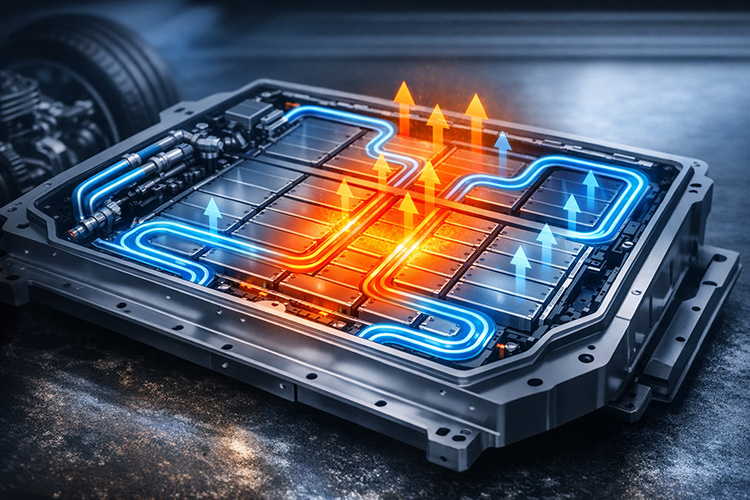
Today’s thermal management systems typically rely on liquid-cooled plates or channels that transfer heat between cells and coolant pathways. These designs perform well under moderate charging conditions, but ultra-fast charging introduces significantly higher thermal loads. Without rethinking the flow paths and system-level architecture, that extra heat can accelerate cell aging and reduce long-term performance.
From cooling to complete thermal control
Modern thermal management isn’t just about removing heat — it’s about controlling temperature intelligently.
Efficient heat transfer pathways not only improve cooling in high-load conditions but also enable faster and more consistent warm-up in cold environments, which supports charging reliability and winter range. Future architectures may even allow direct cell-level thermal control, helping optimize energy delivery and efficiency from the inside out.
Designing smarter with AI and simulation
Emerging tools like advanced simulation and AI-driven design are reshaping how engineers approach thermal management. During early concept phases, advanced simulations with AI support can predict thermal behavior faster and dynamically adjust design parameters to maintain stability under diverse operating conditions. This helps engineers’ model countless “what-if” scenarios before a single prototype is built — saving time, cost and materials.
In operation, AI can further optimize thermal performance in real time by analyzing cell temperature data, predicting hotspots long before they occur, and fine-tuning coolant flow to prevent degradation before it begins. The result: improved safety, extended battery life, and higher charging efficiency — all built on data-driven insight.
Paving the way for scalable innovation
As the industry advances toward higher energy densities and faster charging, the demands on thermal systems will only grow. Intelligent thermal management represents not just a safety measure, but a competitive advantage — enabling faster charging, longer range, and more resilient batteries across every electrified platform.
By combining engineering expertise with AI-enabled design and control, the next generation of battery thermal management systems will help shape a future where electrified vehicles are more efficient, adaptable, and sustainable than ever before.

FAQs
Martin_Winter_FAQs
Why is thermal management becoming more critical than battery size across electrified vehicles?
Across battery electric vehicles, plug-in hybrids, and range-extended systems, battery performance depends on maintaining a narrow operating temperature window. Larger batteries alone cannot compensate for thermal stress caused by high charging power, repeated cycling, or variable operating modes. Intelligent thermal management enables consistent performance, safety, and longevity regardless of vehicle architecture.
How do thermal demands differ between BEVs, hybrids, and range-extended EVs?
While BEVs often face the highest sustained thermal loads during fast charging, hybrids and EREVs experience frequent transitions between electric and combustion-based operation. These dynamic operating modes introduce unique thermal challenges, including rapid temperature changes and uneven heat distribution. Effective thermal systems must adapt in real time to ensure stability and efficiency across all use cases.
What role does thermal management play in charging performance and cold-weather operation?
Thermal management influences both how quickly a battery can accept charge and how reliably it performs in cold climates. Efficient heat transfer supports faster charging in high-load conditions and enables controlled warm-up at low temperatures. This improves charging consistency, winter range, and overall drivability across electrified platforms.
How are AI and simulation improving thermal system design for electrified powertrains?
Advanced simulation and AI-assisted design allow engineers to evaluate thermal behavior across diverse operating scenarios early in development. These tools help optimize system architecture for different electrification strategies, from full electric to hybrid and range-extended applications. In operation, AI can further enhance thermal control by predicting hotspots and dynamically adjusting system behavior before degradation occurs.
Why is intelligent thermal management a strategic differentiator for electrified vehicle platforms?
As electrified vehicles diversify in form and function, scalable thermal management becomes a foundation for platform flexibility. Intelligent thermal systems support faster charging, improved efficiency, and longer component life across multiple vehicle architectures. This makes thermal management not just a protective function, but a key enabler of performance, adaptability, and sustainable electrification.
We want to hear from you
Send us your questions, thoughts and inquiries or engage in the conversation on social media.
Related Stories
4-min read
The Real Challenge of Software-Defined Vehicles Isn’t Software
Read story
5-min read
ClearView™ Vision System: One Platform, Four Ways to See More
Read storyStay connected
You can stay connected with Magna News and Stories through email alerts sent to your inbox in real time.