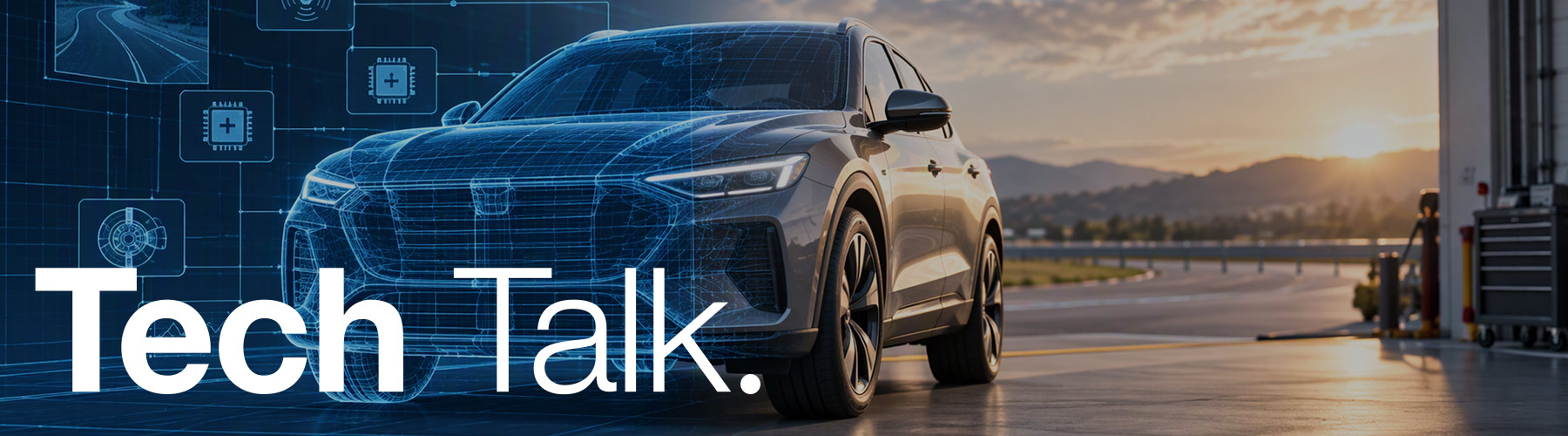

Black vehicle driving along a road at dusk with the sun setting, lake and city skyline in the background. With text Tech Talk.

Why Software-in-the-Loop Testing is Only as Strong as the System Around It

Key Takeaways

  • SiL testing allows software integration to begin before all physical hardware is available
  • Many software risks emerge at the interfaces between vehicle systems
  • Test volume cannot compensate for weak models, poorly designed test conditions or traceability
  • SiL works best when connected to hardware and physical vehicle validation

Software-in-the-loop (SiL) testing can help reduce vehicle integration risk by exposing software and system interactions earlier, but running more virtual tests does not automatically create greater confidence. What matters is the quality of the virtual environment and how well it remains connected to physical validation.

A software function can behave exactly as expected in isolation and still create problems once it becomes part of a vehicle.

That is because many integration problems are not found within the code itself. They typically appear at the interfaces where software interacts with its environment, including networks and physical components such as controllers, sensors and actuators. Increasingly, these interfaces extend beyond the vehicle to backend systems, cloud services and vehicle-to-everything (V2X) connectivity. Those elements may come from different teams and suppliers, evolve on separate schedules and reach maturity at different times.

A change to one component or software version can have effects elsewhere in the system. As vehicle functions span more domains, finding and managing those interactions becomes a larger part of the engineering challenge.

SiL testing brings that work forward. Production-intent software can interact with virtual representations of the surrounding systems before all the physical hardware is available. Integration can begin earlier and continue as the design evolves, rather than waiting for a late-stage test event.

The result is not simply more testing. It is more opportunity to learn while there is still time to act on what is found.

Speed is Useful. Confidence is Harder.

SiL environments make it possible to automate tests, repeat them across different operating conditions and rerun the same scenarios after software changes. Regressions and unexpected system effects can surface sooner, before limited hardware availability begins to slow the process.

Yet speed alone says little about the quality of the answer.

Every simulation is built from models, assumptions and defined interfaces. If the models do not accurately represent the relevant physical components and operating conditions, the software may appear to function correctly, but for the wrong reasons.

Test volume can be misleading, too. Thousands of scenario variations may sound comprehensive, but the number matters far less than whether those scenarios reflect the requirements, interfaces and risks most likely to expose a problem.

Then there is configuration. Vehicle software changes quickly, and individual components are rarely updated in lockstep. Validation must account for different ECU update cadences, cross-platform architectures, regional variants, vehicle launch timing and feedback from different operating conditions. Teams need to know which software versions, models, parameters and conditions produced each result across all these dimensions. Without that traceability, even a technically sound test can be difficult to reproduce or trust.

Cloud-based containerized environments make it easier to run large test sets and reproduce them across teams and locations. Connected to a continuous integration workflow, they can quickly flag issues introduced by a software change.

That scale is valuable, but it cannot rescue an incomplete model or poorly designed test. It only amplifies the engineering decisions already built into the process.

Virtual and Physical Testing Need Each Other

SiL is not a substitute for hardware-in-the-loop (HiL) testing or validation in a physical vehicle. Some behavior cannot be represented accurately enough until real controllers, network timing, environmental effects and physical interactions are involved.

Each stage answers different questions. SiL is well suited for evaluating software behavior and exploring system interactions before hardware becomes the bottleneck. HiL testing introduces physical controllers and real-time behavior. Vehicle testing shows how the complete system performs in the real world.

The value grows when those stages operate as one connected process.

Requirements, scenarios, configurations and results should carry forward instead of being rebuilt at each step. The flow also needs to work in reverse. If an issue appears during hardware or vehicle testing, engineers should be able to reproduce it virtually and add it to future regression testing. Physical results can also help refine the models used in SiL, making later virtual testing more representative.

This ongoing exchange is what turns SiL from an early testing tool into a broader integration discipline.

Vehicle software will continue to grow in scale and complexity, bringing more testing with it. However, the number of simulations run is not the best measure of progress.

A more meaningful measure is how many unknowns have been resolved before software reaches hardware, leaving physical testing to focus on the questions only a physical system can answer. The goal is not to replace physical testing, but to make every stage of validation more effective.

Learn how Magna brings software, hardware and systems engineering together to advance next-generation vehicle development. Explore Magna’s Complete Vehicle Engineering Capabilities at www.magna.com/products/complete-vehicles/complete-vehicle-engineering.

Head shot of David Ludwig, Sr. Director, Electrical System, Magna

David Ludwig

David Ludwig is a Senior Director, Electrical System, for Magna’s Vehicle Engineering team. He has extensive experience in electrical and electronic systems engineering, vehicle integration, software-driven vehicle architectures and validation methodologies. In his current role, he leads global engineering activities focused on electrical systems development, integration and validation, supporting customers as vehicle architectures become increasingly software-defined.

FAQs

What is software-in-the-loop testing in automotive development?

Software-in-the-loop, or SiL, testing evaluates vehicle software in a virtual environment before all physical hardware is available. Production-intent software can interact with models representing sensors, controllers, networks and physical systems, allowing engineers to assess software behavior and system interactions earlier in development.

How does SiL testing reduce vehicle software integration risk?

SiL testing helps expose problems at the interfaces between software, hardware and other vehicle systems before physical integration. Tests can be automated and repeated as the software evolves, making it easier to identify regressions, unexpected interactions and configuration issues while there is still time to address them.

Why doesn’t running more SiL tests automatically improve validation?

Test volume matters only when the models, scenarios and system configurations accurately represent the risks being evaluated. An incomplete model or poorly selected scenario can produce misleading results, even at large scale. Meaningful SiL validation depends on model quality, requirements-based testing, traceability and reproducible test conditions.

How do SiL, hardware-in-the-loop and physical vehicle testing work together?

SiL testing evaluates software logic and system interactions virtually. Hardware-in-the-loop testing adds real controllers, networks and timing behavior, while physical vehicle testing confirms how the complete system performs in real-world conditions. Results should flow between all three stages so physical findings can refine virtual models and strengthen future regression testing.

How does Magna support OEMs with software-in-the-loop testing and vehicle integration?

Magna supports OEMs by connecting software, system and complete-vehicle engineering with virtual and physical validation, helping teams evaluate not only whether software works, but how it behaves across the broader vehicle system.

We want to hear from you

Send us your questions, thoughts and inquiries or engage in the conversation on social media.

Related Stories
DHD DUO: A Scalable Hybrid Architecture for a Market That Demands Flexibility

Article

Beyond One-Size-Fits-All: A Scalable Approach to Range Extenders

Article

Beyond the Specs: How Systems Thinking is Reshaping EV Design

Article

Bridging the Gap: Hybrids and the Road to Electrification

Article

Stay connected

You can stay connected with Magna News and Stories through email alerts sent to your inbox in real time.