
4-min read

Material Science is Driving a Brighter, Lighter Future
From the development of plastics and other lightweight composite materials to sustainable paint processes and countless other innovations, material science has always been at the core of product design and manufacturing. It’s all about the quest to make products better and more efficient with greater value, safety and sustainability.
This has never been more important than in the transition to the Car of the Future, where recycled, renewable and lower-impact materials and processes are becoming increasingly important. Our industry strives to minimize its environmental impact and address growing concerns about climate change, resource depletion, and waste generation.

Parvinder Walia, Director of Material Science
Innovations in Automotive Materials
The increased focus on materials in design and manufacturing reflects a broader societal movement toward responsible production and consumption. This movement seeks to balance economic growth with environmental preservation and social responsibility.
In the automotive world, the drive to electrification is fueling materials innovations. There is a focus on lightweight materials that support greater driving ranges and flame retardants in battery spaces to enhance safety. With translucent materials, lighting can be hidden behind them to streamline designs. Sensor integration for driver assistance and autonomous driving is enabled through new materials and solutions that keep the sensor cover clean from the elements (i.e., ice, rain, etc.).
Advancements in Manufacturing Processes
One of the biggest areas of material innovation is taking place in the paint booth. The typical vehicle-painting process involves environmental challenges and paint waste. A collaborative project we’re working on with a university is looking at transforming paint sludge waste into a filler for plastics. Our Polycon division is taking an innovative approach, incorporating that filler from the paint sludge waste into a plastic foam molded right there, bringing circularity to the process.
A new in-mold paint process, still in the development stage, provides an alternative to traditionally sprayed paint with a colored material that’s molded with the plastic substrate. The result is almost 100% efficiency and a drastically lower environmental impact through reduced waste and lower energy consumption.

Pellets made from unsorted household waste, used in a front end module (FEM)
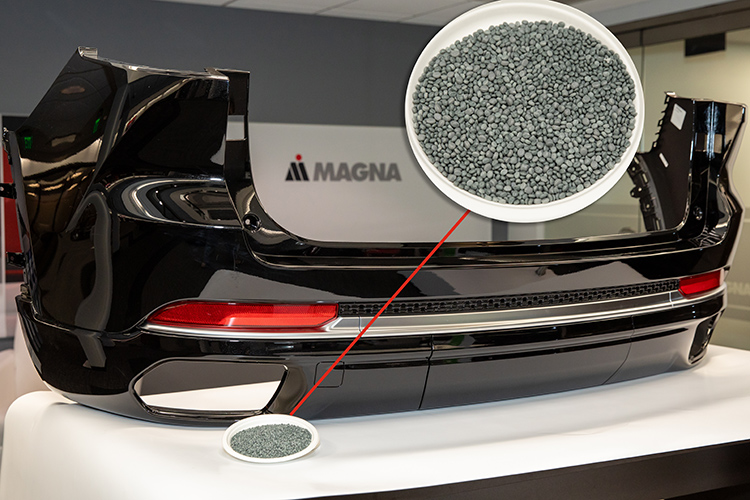
Pellets made from post-consumer recycled materials, used in a bumper
Sustainable Materials and Their Benefits
Metals such as aluminum and steel require large amounts of energy to produce, and their extraction can result in habitat destruction, pollution, and other environmental harms. In contrast, sustainable materials like bamboo, hemp, or recycled metals can be sourced with a lower environmental footprint. They often require less energy to process and are abundant or renewable resources.
One innovative project is looking at using household waste-based carbon negative materials as an additive in plastic. Even a 5% use of this material can lower carbon footprint by 30%. There has also been a strong advancement with a project that could see hemp-based automotive products such as roof racks in production.
All the examples described here are part of Magna’s innovation pipeline, which includes performance materials, sustainable materials, and materials engineering to support Magna Exteriors. There’s also a strong need to find alternative materials for customers’ service parts.
Regardless of the application, innovative materials and waste-reducing processes can improve material circularity, reduce waste and increase resource efficiency throughout the manufacturing lifecycle.
Another significant advantage of material advancements is their contribution to a circular economy. Unlike the linear "take, make, dispose" model of traditional manufacturing, the circular strategy aims to keep materials in use for as long as possible through practices like recycling, remanufacturing, and repurposing. This approach is fundamental to Magna’s ambitious net-zero targets, including the company’s goal to reduce Scope 3 emissions by 25% by 2030.
As consumers and businesses increasingly prioritize sustainability, manufacturers that incorporate recycled, renewable and lower-waste materials in their products, along with more efficient production processes, will be well positioned for the future. Moreover, sustainable materials can foster cost savings over time, particularly as energy-efficient production methods and waste reduction strategies reduce operational costs.
Material science has always been the backbone of innovation for design and manufacturing, and in the new era of mobility, it’s never been more important.

We want to hear from you
Send us your questions, thoughts and inquiries or engage in the conversation on social media.
Related Stories

4-min read
5 Sustainable Materials Shaping the Next Vehicle Program
Read story
4-min read
Magna Expands Long-Term Innovation Partnership with Mercedes-Benz
Read storyStay connected
You can stay connected with Magna News and Stories through email alerts sent to your inbox in real time.