Setting a sustainability target is often the cleanest part of the job. Delivery is more complicated.
It happens through material specifications, equipment decisions, plant investments, supplier engagement and the many tradeoffs behind every vehicle program.
At Magna, we have seen how quickly a promising idea runs into real-world constraints. A lower-impact material must meet the same expectations for durability, cost and availability as any other. An energy project that works well in one facility may not translate directly to another. And many of the decisions that shape the overall impact are made throughout the supply chain.
Making progress at this scale means building sustainability into everyday business decisions, not treating it as a separate workstream.
Build Sustainability into the Operating System
Many of the best opportunities come from the teams closest to the equipment. For instances, they know where compressed air is being wasted, when HVAC systems are working harder than necessary and where heat from one process could be recovered and used elsewhere.
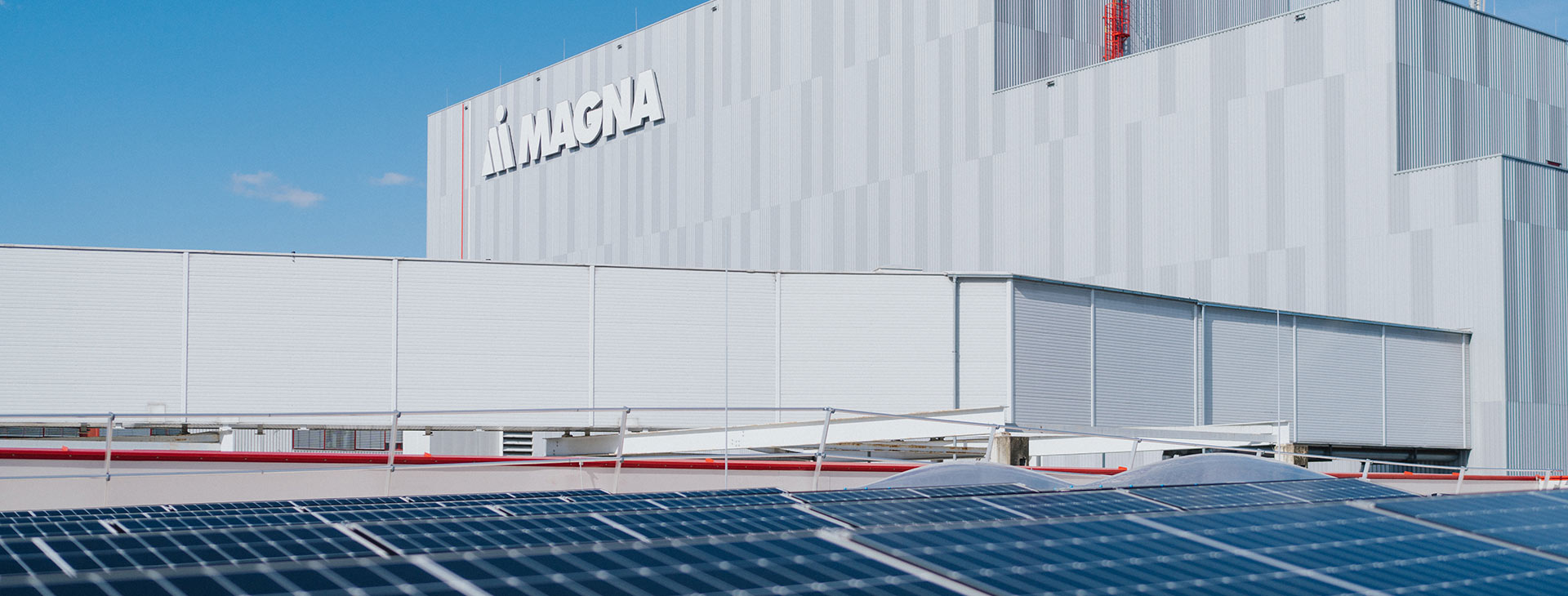
Magna’s Energy Cost Optimization initiative, Eco50, gives division teams a structure for identifying and implementing those opportunities. Projects have ranged from equipment and process improvements to waste-heat recovery and on-site renewable electricity generation. In 2025, energy-reduction projects implemented across Magna saved nearly 249,000 MWh, enough to power approximately 24,000 homes for a year.
Better information is helping teams act sooner. Energy sensors, connected equipment and monitoring systems are becoming important building blocks of the factory of the future, providing greater visibility into how operations consume energy and resources. These tools can show where consumption is rising, where equipment may not be operating properly and which processes deserve a closer look. The value is not another dashboard. It is giving people who understand the operation useful information while there is still time to act, helping them make decisions that improve efficiency, reduce waste and support more sustainable manufacturing.
The results extend beyond individual projects. In 2025, Magna achieved 100% renewable electricity across its European operations. Globally, on-site renewable electricity generation reached 81,595 MWh, roughly ten times the 2023 level.
We track energy and carbon intensity, renewable electricity, water consumption, waste diversion and project savings across our manufacturing footprint. That common view helps us identify where performance is improving, where more attention is needed and which approaches can be adapted elsewhere.
Make Lower-Impact Materials Work in Real Programs
Material does not earn its way into a vehicle program on environmental benefits alone. It still has to perform.
One of the biggest challenges in sustainable materials is balancing environmental benefits across an entire product lifecycle. A material may reduce emissions or resource use during production, but create new challenges when a vehicle reaches the end of its life and needs to be recycled or recovered. The same careful evaluation applies to renewable materials, where teams must consider factors such as land use, biodiversity and long-term resource availability.
Automotive programs can remain in production for more than a decade, so engineers and sourcing teams also need confidence that sustainable materials can be supplied consistently and at scale for years to come. Helping make sure those tradeoffs are understood and addressed is a critical part of turning promising materials into practical, long-term solutions for the industry.
Our sustainable materials work focuses on increasing recycled content, advancing circular-material solutions, renewable materials, end-of-life recyclability and products that improve vehicle efficiency. Teams across Magna are advancing options such as recycled aluminum, natural-fiber composites and bio-based or recycled interior materials. That work also extends into complete-vehicle engineering, where design and environmental compliance are considered alongside other program requirements.
Finding new, interesting material is only the beginning. The hard part is engineering, validating, sourcing and industrializing it without losing the environmental benefit that made it worth pursuing.
Extend Progress Beyond Company Boundaries
No automaker or supplier controls the entire automotive value chain. Materials, components and energy decisions made throughout the supply chain all affect the final outcome.
Transform: Auto is one way Magna and other automotive companies are working on that challenge together. The initiative gives suppliers education, expert guidance and access to collaborative renewable-electricity procurement opportunities. After engaging more than 800 suppliers in North America, it expanded to support companies with operations in Europe, the United Kingdom, Türkiye and Morocco.
We are also incorporating sustainability more directly into our supplier processes. More than 3,300 suppliers have completed Magna’s ESG scorecard, and our Supplier Environmental Performance disclosure program and related reporting requirements are helping create greater visibility across the supply base.
Reporting has a role, but asking suppliers for more data is not enough. Suppliers may operate in different markets, with different energy systems, regulations and commercial realities. Progress requires clear expectations and practical pathways that account for those conditions.
A Standard Built for the Real World
At automotive scale, sustainability ideas have to survive contact with the real world.
They must be technically sound, commercially workable and available at scale. They need to hold up through validation and production, while also making sense for the people responsible for putting them into practice.
The aim is to make sustainability part of how vehicles are designed, sourced and built, rather than create a separate system around the automotive business.
That is what turns targets into outcomes.
Take a closer look at five sustainable material pathways moving toward production and the engineering, sourcing and manufacturing requirements each must meet.