
Inside the Inverter: How Power Modules Help OEMs Manage Complexity
Key Takeaways
- Power modules are a critical driver of inverter performance, efficiency and system cost
- OEMs are under growing pressure to manage complexity across vehicle programs, voltage architectures and semiconductor technologies
- Magna's scalable platform enables flexibility across both silicon and silicon carbide technologies using a common architecture approach
- Close collaboration across the semiconductor ecosystem, combined with chip-agnostic sourcing flexibility, helps OEMs adapt to evolving market needs
As EV portfolios expand, OEMs are balancing more variables than ever before. Different vehicle programs often require different performance targets, voltage architectures, semiconductor technologies and sourcing strategies. This creates new layers of engineering and supply-chain complexity.
Increasingly, the challenge isn't simply electrification itself. It's finding ways to scale across diverse vehicle programs while controlling cost, reducing complexity and maintaining the flexibility to adapt as market demands evolve.
One technology helping OEMs address that challenge sits deep inside the inverter.
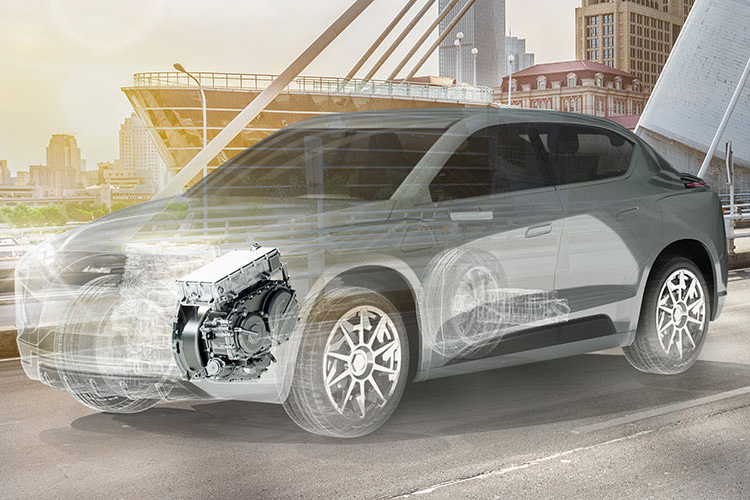
The inverter converts battery energy into the power needed to drive an electric motor, making it one of the most important components in an eDrive system. At the heart of the inverter is the power module, which controls how electrical energy is delivered to the motor and directly influences efficiency, thermal behavior, packaging, performance and overall system cost.

Power module variants enable flexibility across vehicle platforms, performance requirements and voltage architectures.
Historically, different vehicle programs often required different inverter variations to accommodate varying performance targets, voltage levels and semiconductor technologies. As EV portfolios expand, OEMs are increasingly seeking ways to support a broader range of applications without continually redesigning core systems.
Magna Power Modules, part of Magna’s EtelligentPower™ product family, were developed with a different philosophy. Rather than treating each application as a separate engineering challenge, Magna created a scalable power module platform designed to support multiple vehicle programs through a common architecture approach.
One Architecture, Multiple Applications
Not every EV is designed with the same objectives in mind. Some vehicle programs prioritize affordability and accessibility. Others focus on maximizing range, efficiency or performance. Increasingly, OEMs need the flexibility to support all of those requirements across a growing portfolio of vehicles.
One reason is the growing use of different semiconductor technologies. Today's electrified vehicles increasingly leverage either silicon (Si) or silicon carbide (SiC) semiconductors, each offering distinct advantages depending on the application.
Si-based solutions can be well suited for cost-focused vehicle programs and many lower-power applications. SiC-based solutions can offer improved efficiency, thermal performance and high-voltage capability, making them attractive for applications where efficiency and performance are priorities.
Rather than forcing OEMs to choose a single technology strategy across every vehicle program, Magna's platform approach enables a common inverter architecture that can scale between Si and SiC technologies depending on vehicle objectives. This helps support greater platform reuse while giving OEMs the flexibility to balance cost, efficiency and performance across multiple applications.
Flexibility Across a Changing Semiconductor Landscape
As semiconductor technologies continue to evolve, OEMs are looking for partners that can combine deep technical expertise with long-term sourcing flexibility. Magna's development approach reflects both priorities.
Through close collaboration with industry leaders such as onsemi, Magna has accelerated the development and commercialization of its power module technology while leveraging its own expertise in inverter design, system integration and electrified propulsion systems. At the same time, Magna's platform is designed with flexibility in mind.
Its architecture supports a chip-agnostic sourcing approach that can help OEMs adapt to evolving technology roadmaps, regional requirements and supply-chain considerations as vehicle programs scale globally. The result is a solution that combines the benefits of deep technical collaboration with the adaptability OEMs increasingly require across global vehicle portfolios.
Designed for Adaptable Electrification
Magna Power Modules are designed from a systems perspective, drawing on expertise in eDrive systems, inverters, controls and propulsion-system integration. The platform supports both 400V and 800V architectures, allowing OEMs to leverage a common foundation across a broad range of vehicle applications.
The modules are engineered with compact packaging, low stray-inductive design and integrated cooling considerations to support efficient inverter integration and thermal management. They can be integrated into Magna's next-generation eDrive systems or supplied as stand-alone solutions for OEM integration, giving customers flexibility in how they deploy the technology.
Most importantly, Magna's scalable power module architecture is designed to help OEMs navigate the realities of modern electrification. As performance requirements, voltage architectures, semiconductor technologies and sourcing strategies continue to evolve, the ability to adapt without continually redesigning core systems becomes increasingly valuable.
Power modules may sit inside the inverter, but their impact extends throughout the propulsion system. By bringing its system-level expertise into one of the most critical elements of electric propulsion, Magna is helping OEMs address complexity, improve flexibility and support more adaptable electrified vehicle architectures.
To learn more about Magna Power Modules and the EtelligentPower™ portfolio, visit www.magna.com/products/powertrain/modules-and-components/power-module.

We want to hear from you
Send us your questions, thoughts and inquiries or engage in the conversation on social media.
Related Stories
Stay connected
You can stay connected with Magna News and Stories through email alerts sent to your inbox in real time.