4-min read

Beyond One-Size-Fits-All: A Scalable Approach to Range Extenders
Electrification is no longer a linear transition. Across major markets, OEMs are navigating a mix of regulatory pressure, uneven charging infrastructure, and shifting consumer expectations — all of which are moving at different speeds.
That reality is reshaping how powertrain strategies are being defined. Rather than committing to a single pathway, OEMs are increasingly looking for solutions that can adapt across regions, vehicle segments, and use cases.
That’s a big part of why range extenders are back in focus.
Not as a step backward from full electrification, but as a more flexible way to deliver electric driving characteristics while addressing real-world limitations around range, infrastructure, and cost.
Why Range Extenders are Gaining Momentum Again
The drivers behind this shift vary by region, but the underlying challenge is consistent: electrification is progressing, just not uniformly.
Range-extended electric vehicles (REEVs) have become a fast-growing category in China, shaped by regulatory frameworks that favor electrified architectures without direct mechanical reliance on internal combustion engines.
In North America, interest is driven less by regulation and more by consumer expectations, particularly the need to deliver EV-like driving without the limitations of inconsistent charging infrastructure in rural and long-distance use cases.
With evolving emissions policies, Europeans are reopening the conversation around hybrid architectures as part of a more flexible transition.
The implication is clear: OEMs are no longer optimizing for a single end state. They are building portfolios that can respond to regional requirements and real-world usage, and that requires more adaptable powertrain solutions.
A Portfolio Approach to Range-Extender Solutions
Meeting those demands requires more than a single architecture.
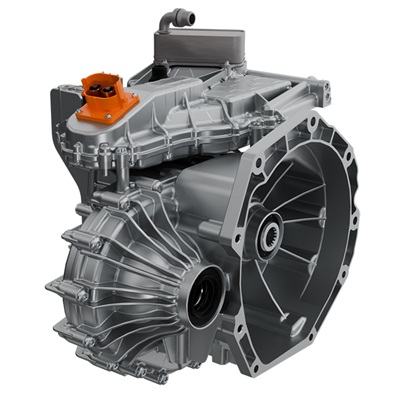
At Magna, this has led to a portfolio approach built around scalable Dedicated Hybrid Drive (DHD) systems — supporting both single and dual-motor configurations depending on the vehicle, market, and application.
Within this portfolio, two solutions define Magna’s range-extender strategy:
- DHD REX, a compact, single-motor architecture optimized for cost efficiency, packaging simplicity, and applications where serial operation and an electric-driving experience are prioritized
- DHD Duo, a dual-motor system designed for greater flexibility, enabling both serial and serial-parallel operation across a broader range of performance and use cases including PHEV architectures
Together, these systems allow OEMs to align powertrain strategy to real-world constraints, whether that means meeting strict regulatory definitions, enabling BEV-derived architectures, or balancing efficiency, capability, and cost across global markets.
DHD REX: A Simpler Approach to Range Extension
Within this portfolio, the DHD REX represents a more streamlined approach to range extension, designed for applications where cost efficiency, packaging, and regulatory alignment take priority.
Built as a single-motor system, it alternates between propulsion and energy generation. In eDrive mode, it supports traction and vehicle dynamics; in generating mode, it charges the battery while the primary eDrive propels the vehicle.
This “either-or” architecture simplifies the system while maintaining the core benefit of range extenders: delivering electric driving characteristics—such as smooth acceleration, quiet operation, and responsive torque—without being fully dependent on charging infrastructure.
For OEMs, that simplicity translates into:
- fewer components and reduced system complexity
- improved packaging flexibility across vehicle platforms
- a more cost-efficient pathway to electrification
The system can be configured for both transverse and longitudinal installation and is well suited to applications that must comply with strict REEV requirements (such as those in China) while also supporting a parallel mode in less regulated markets.
DHD DUO: Scaling Flexibility and Capability
Where greater flexibility, performance, or application range is required, the DHD Duo extends this approach through a dual-motor architecture.
With one motor dedicated to propulsion and the other to energy generation, the system operates continuously without switching modes in a purely serial configuration. By adding a 1- to 4-speed gearset, a serial-parallel layout can also be enabled, introducing switching between serial and parallel modes.
This enables broader application across:
- higher speed
- vehicles with increased traction or towing demands
- use cases where parallel operation improves efficiency
With configurable gearing for parallel operation, the system can be tuned for efficiency, performance, or capability depending on the vehicle program.
Matching Architecture to Application
The choice between single- and dual-motor range-extender architecture ultimately comes down to application.
For urban-focused vehicles or markets with strict regulatory frameworks, a simplified system like DHD REX offers a cost-efficient path.
For larger vehicles, light trucks, or applications requiring sustained all-wheel drive or towing capability, a more flexible system like DHD Duo may be better suited.
As OEMs expand electrification across their portfolios, the ability to match architecture to application rather than rely on a single solution is becoming increasingly important.
A Flexible Path Forward
Electrification is advancing, but not uniformly.
As regional requirements, infrastructure readiness, and customer expectations continue to diverge, OEMs need solutions that can scale without adding unnecessary complexity or cost.
Magna’s DHD portfolio is built around that reality, enabling flexible range-extender strategies across segments, markets, and timelines.
For a deeper look at system architectures, operating modes, and application fit, explore Magna’s range-extender solutions or download the full technical paper.

We want to hear from you
Send us your questions, thoughts and inquiries or engage in the conversation on social media.
Related Stories
5-min read
ClearView™ Vision System: One Platform, Four Ways to See More
Read story
5-min read
Why AI Success Starts with Business Value and Process Redesign
Read storyStay connected
You can stay connected with Magna News and Stories through email alerts sent to your inbox in real time.