AI techniques and tools are beginning to impact every part of the ADAS design, build, and testing process.
Each stage is affected in unique ways, but all are being enabled by the same underlying advances in technology.
On the design side, even traditionally behind-the-scenes tasks are being overhauled.
As one example, we are starting to see tools that can automate requirements management, such as identifying overlaps between requirement documents from multiple customers, which has historically been tedious and error-prone for humans.
ADAS Is Entering a Third Era
In the realm of real-world ADAS features running in vehicles, we are entering a third era. The first era, prior to 2012, involved hand-coded systems for both perception and drive policy.
Perception required teams of computer vision engineers to craft image descriptors that could be extracted and matched.
Drive Policy relied on fragile rules and heuristics to control steering and acceleration to achieve driving goals.
Over the last decade, the second era emerged with the introduction of Convolutional Neural Networks (CNNs), which largely replaced manual feature extraction in perception, though Drive Policy remained largely rule-based.
Now, with the introduction of transformer models and foundation models, we are entering a third era.
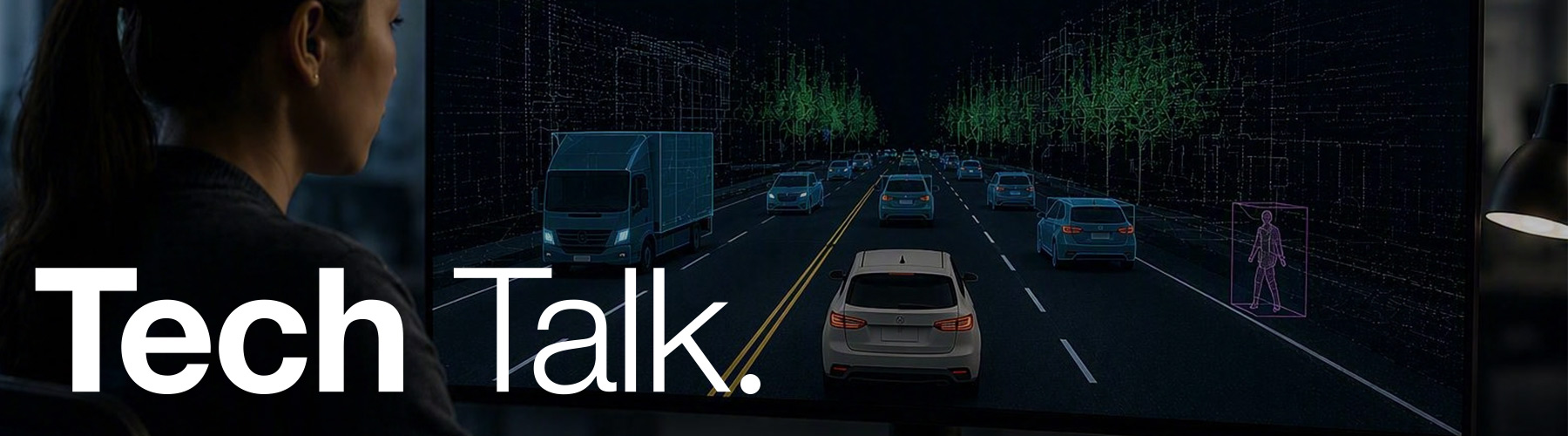
Drive Policy is beginning to be replaced similarly, with early signs of integrating the subsystems into a single "End to End Model," where AI is trained to take in the sensor data and emit control signals directly—much like how human drivers operate.
AI Is Accelerating Simulation
Finally, it is well known that large quantities of data are needed to train and evaluate the models and systems. This type of data collection on real roads with real vehicles is tedious and expensive.
AI is playing a significant role here through simulation.
Tools now enable the creation of massive, powerful datasets without ever leaving the office, leading to significant cost savings and faster project timelines.
These simulations can generate video game-like data and, with the latest models, even use natural language commands to modify real-world data.
For example, commands such as "add rain to the scene" can produce new datasets with water on the roads and even droplets on camera lenses.
While not yet fully mature, these capabilities are rapidly advancing, and soon we will have augmentation features where commands like "add more traffic" will generate the desired scenarios.
Keeping Pace With Innovation
While these paradigm shifts present challenges, it's clear that AI is having a revolutionary and lasting impact.
The current challenge is to keep pace with rapid developments and harness this technology to make real-world driving safer and more comfortable, despite its enormous complexity.