
9-min read

The Top 3 Challenges For a Stable Automotive Supplier Network
Automotive suppliers have a vital role in the automotive manufacturing process. They make up the largest part of the manufacturing environment and are responsible for providing most of the systems and components in a vehicle.
This article gives an overview of automotive suppliers and the challeng-es a new entrant may face when establishing their own automotive supplier network.
AN INTRODUCTION TO AUTOMOTIVE SUPPLIER NETWORKS
Usually, only a small number of vehicle components is produced directly in-house with most systems and individual components delivered by suppliers. An average vehicle is composed of systems delivered from hundreds of different supply sites. As such, the quality of a vehicle’s supply network can affect the quality and development of the vehicle itself.
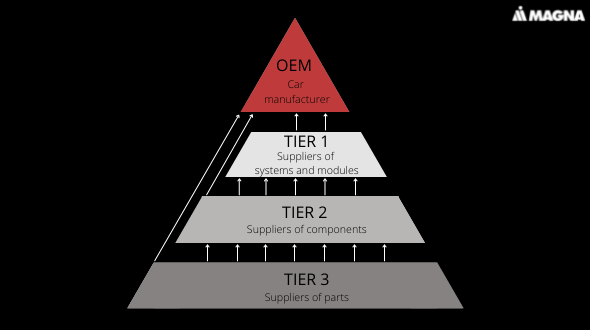
Automotive suppliers are grouped into three categories:
- Tier 1: Suppliers that provide systems and modules - they are responsible for development and production and deliver directly to the car manufacturer. An example would be an EV battery supplier.
- Tier 2: Component suppliers that deliver parts to Tier 1 (e.g. battery housing). These are often called "build to print" suppliers, with no system development capability.
- Tier 3: Raw material (plastic granulate for housing) and standard parts suppliers (screws and connectors for harnesses).
As complete vehicle manufacturers (OEM’s and new entrants) usually interact directly only with tier 1 and to a lesser degree with tier 2 suppliers, the term “suppliers” in this article refers to tier 1 suppliers.
ESTABLISHING AN AUTOMOTIVE SUPPLIER NETWORK
One of the most important factors when establishing a supply network is to consider the transport distance. If a new entrant plans to build-up a greenfield site, they should choose a location within the vicinity of as many key suppliers as possible. Being near suppliers is beneficial in terms of time and cost. It also reduces the vehicle’s environmental footprint - which helps to meet regional climate regulations.
Which Automotive Suppliers Are the Most Important?
Another key factor is the complexity of the supplied parts. More com-plex systems such as e-drive units, EV batteries or ADAS tend to have a longer development schedule.
Therefore, to ensure an efficient development and production process, these suppliers should be onboarded as early as possible. Preferably, this happens during the concept phase as soon as the targets related to their systems are clearly defined.
Additionally, the supplier’s own supply network (Tier N structure ) must also be taken into consideration.
If suppliers have longer lead times for tooling or purchase parts, the start of production (SOP) of the vehicle and the resulting series production could be affected. Thus, potential shortfalls or delays should be considered in risk management. Current examples are the semiconductor and material shortages during the COVID-19 pandemic. Furthermore, the political situation of suppliers’ plant locations and possible disruptions of supply chains need to be considered.
How much should be produced in-house
New entrants might also be concerned about how much control they will have over their vision and its unique value within the market. It might seem contradictory to work with multiple external suppliers who also supply parts to competitors, while wanting to create a unique vehicle that stands out in the market.
Most automotive manufacturers prefer outsourcing much of the development of their systems and modules to system suppliers instead of having the large cost margin that comes with a high vertical integration.
There are two further reasons why outsourcing is typically more beneficial:
- Suppliers are specialized manufacturers. Many systems have a high degree of complexity and as such, their production requires skill and experience. Suppliers of such systems typically have the know-how and infrastructure necessary to develop and manufacture these systems as efficiently as possible. They also benefit from the experience gained from past projects.
- Suppliers also want to differentiate themselves from their competition. Ultimately, suppliers and their customers are equally reliant on each other to keep their respective businesses running. Good suppliers are aware of the current automotive trends toward more vehicle individualization, and it is in their best interest to develop new and unique solutions for the market. Thus, the quality and the technical uniqueness of the complete vehicle may benefit from outsourcing systems to specialized suppliers.
In many cases, OEMs shift from in-house development and production towards more systems provided by external partners. For new entrants, it often makes more sense to purchase systems than to build up the necessary in-house capacities. Thus, the importance of system suppliers is rising.
THE CHALLENGES OF ESTABLISHING AN AUTOMOTIVE SUPPLY NETWORK
Building and maintaining an automotive supply network is arguably one of the most comprehensive and complex tasks of the vehicle development process. The sheer size of an automotive supply network alone can be very daunting. Building a network requires precise coordination and an extremely robust schedule, which leaves very little room for mis-takes.
However, new entrants should be mindful of more than just the number of suppliers they need.
Onboarding Automotive Suppliers
New entrants may sometimes have difficulty securing suppliers for their project. As new players in the automotive market, they haven’t yet built a reputation and suppliers may be hesitant to work with the unknown. In addition, the challenges that new entrants may face while they are becoming established might result in delays or even termination of their projects – a risk many suppliers don’t want to take.
Even if projects are realized, new entrants generally work with lower production volumes than OEMs until their brand is accepted in the market. This could also discourage suppliers as it may result in higher production costs in relation to expected profits.
Ensuring Supplier Quality
Once suppliers are brought on board, it is their customer's responsibility to ensure that quality standards are met. Customer and supplier stay in constant contact through the Supply Quality Assurance (SQA) department, whose responsibility is to ensure that the supplier keeps their predefined Run@Rate.1 They also ensure that everything runs according to the customer's wishes and that adjustments happen in an efficient and timely manner.
Coordinating the Supply Network
As previously explained, modern automotive manufacturers increasingly pay attention to the cooperation with specialized suppliers to ensure the utmost quality for their systems/components. The main challenge for the new entrant then lies in assembling those systems into the com-plete vehicle.
However, this process is far from simple. If new entrants want to succeed in the market, they need the ability to conceptualize, coordinate and integrate hundreds of systems and components as well as their respective manufacturers within one large organizational network.
Coordinating a supply network also requires time, a valuable and limited resource, especially in automotive development. Delays will inevitably occur at some point during the manufacturing process. The most common causes for delays are:
- Changes in the BOM and concept may require suppliers to adapt their current supply and production chain, which affects the timing schedule for deliveries.
- Delivered components might not meet the expected quality standards due to shortened development times and miscommunication between the stakeholders.
- The suppliers might have problems with their own supply chain. For instance, the 2021 lithium shortage resulted in worldwide delays in the production of EV batteries.
How to Meet Those Challenges
Many of the challenges mentioned in this article can be traced back to issues related to miscommunication or unclear agreement terms between parties. A further challenge could be that communication within the network lacks efficiency. The best way to prevent such issues is to have a foundation of solid communication. This can be achieved in two ways:
- Clearly defined guidelines (Roles and Responsibility Matrix/ RASI)and contracts that specify responsibilities for both parties.
- A solid and efficient digital infrastructure connecting the new entrant’s organization with their partners. For more information on this topic, refer to the article “Why Your IT Landscape Should Not Be Ignored.”
OBTAINING A SUPPLY NETWORK WITH CONTRACT MANUFACTURING
The process of building a supply network can be made considerably easier for new entrants by partnering with an established manufacturer. These manufacturers are often OEMs or tier 1 suppliers themselves, so they already have an established network of suppliers. New entrants who choose to cooperate with contract manufacturers also gain access to their established networks.
This access is not limited to the system suppliers used by the contract manufacturer alone. With an established name backing their project, new entrants also have a much easier job onboarding new suppliers into their network. Entering an environment as complex as the automotive world works best if new players can quickly establish connections. This is where contract manufacturing can be advantageous.
Finally, contract manufacturing provides a fast solution for assembling the vehicle. Contract manufacturers like Magna are experienced specialists in complete vehicle production. With suppliers for individual systems on one side and a contract manufacturer for the complete vehicle on the other, new entrants are more likely to be placing their vision in good hands.
WHAT'S NEXT?
To summarize, establishing a supply network requires a great deal of time and effort as manufacturing a vehicle requires hundreds of system-level suppliers (tier 1 suppliers). Before a new entrant can start building their supply network, they need to identify the most important suppliers and determine how much of their development/production they intend to outsource.
The most common challenges with establishing the supply network are related to the sheer time and cost efforts this process demands, including the effort of onboarding suppliers and ensuring a good cooperation, communication, and product quality with them. Hiring a contract manufacturer can be beneficial because it gives new entrants access to an already existing network as well as a well-known industry name backing their project (which can make the onboarding process easier).
A supply network is not established in a single day. It is a factor that is continuously established and expanded during the project. No successful automotive project can come to fruition without a well-planned and coordinated cooperation network of high-quality suppliers.
Stay connected with Inside Automotive!
You can keep updated with Magna's Inside Automotive through email alerts in real time. Subscribe now!

We want to hear from you
Send us your questions, thoughts and inquiries or engage in the conversation on social media.
Related Stories

Inside Automotive - Downloads
Read story
9-min read
How Integrated Sustainability Effectively Supports Development Processes and Why Quality Matters More Than Speed
Read storyStay connected
You can stay connected with Magna News and Stories through email alerts sent to your inbox in real time.