
9-min read
Styling
in Automotive Design: How Early Decisions Impact Time to Market
KEY TAKEAWAYS:
• Styling is gaining strategic importance in vehicle development, both for perception and for speed to market readiness.
• New visualization capabilities are changing how early design decisions can be made and are increasing expectations at the same time.
• The difference is often not in the concept itself, but in the timing and consistency of decisions.
• Complexity and global collaboration increase the risk of friction losses, making clear alignment a critical factor.
• Despite technological advances, design remains a fundamentally human capability.
STYLING IN TRANSITION: FROM AESTHETIC FACTOR TO STRATEGIC LEVER
The requirements for modern vehicle design have fundamentally changed in recent years. Shorter development cycles, increasing product variety, and a growing standardization of technology in the market are shifting the focus toward what visually and emotionally differentiates vehicles.
While technical platforms and components have become increasingly comparable, styling is taking on a new role. It determines whether a product is noticed, understood, and ultimately purchased.
This development aligns with a broader trend in vehicle development. Decisions are increasingly moved to earlier phases to reduce development time and avoid later adjustments.
Design is therefore no longer just part of the product. It has become an integral element of an accelerated development process.
WHY STYLING PLAYS A GREATER ROLE IN THE MARKET SUCCESS TODAY
Technical solutions are becoming increasingly similar. Platforms, components, and suppliers often differ only in details. As a result, competition is shifting more toward perception.
Styling becomes the visible differentiator. It determines whether a product stands out, creates an emotional impact, and is perceived as relevant. At the same time, expectations for design quality have increased across all segments. Attractive design is now a baseline requirement rather than an added value.
For development projects, this means design must deliver faster while maintaining consistently high quality.
.png?sfvrsn=ed5b6e4d_1 "MAGNA26001-26-Lead-Magnet-Design-Process-AI_CTA(1)")
FASTER VISIBILITY: HOW THE DESIGN PROCESS IS CHANGING
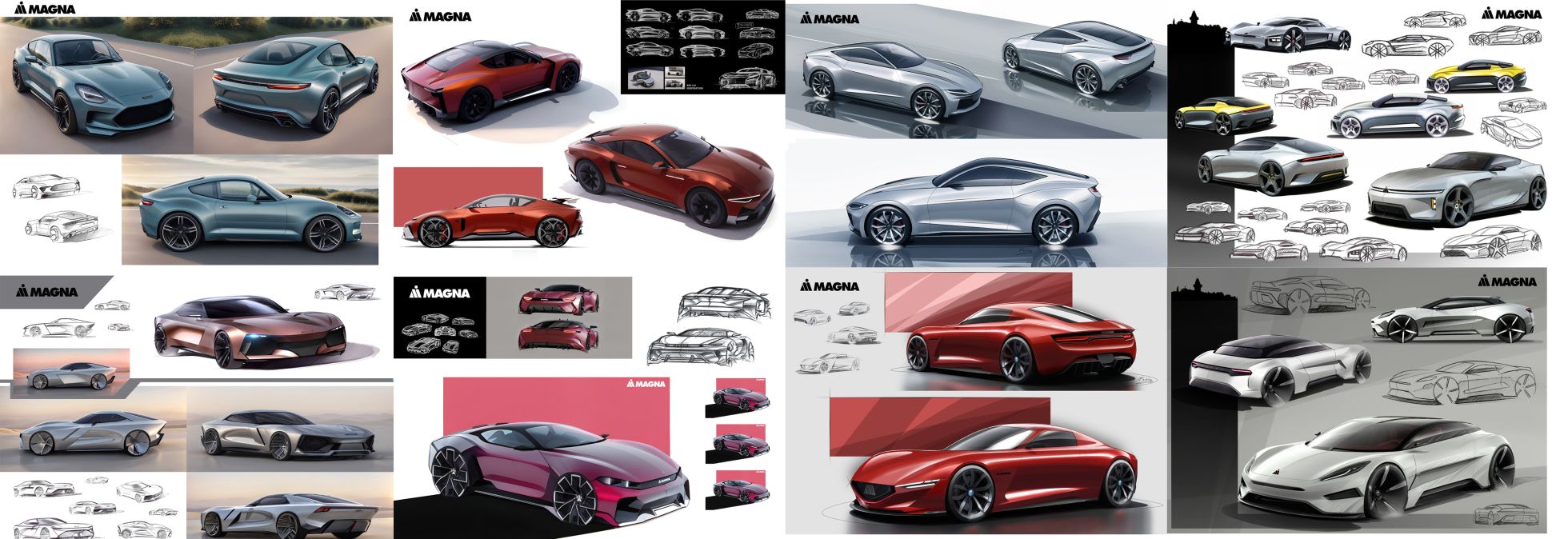
The biggest transformation lies in the speed of visualization. Sketches remain the starting point, but they are now quickly developed into realistic representations at a very early stage.
AI-supported tools enable fast photorealistic rendering of concepts, allow perspective variations, and generate initial animations. This makes design easier to understand earlier and improves communication.
At the same time, the transition into 3D happens much earlier. Volumes and proportions can be assessed sooner, enabling closer integration between design and engineering.
This development follows a clear principle: virtual methods improve the quality of early decisions and reduce later iterations.
At the same time, new pressure is emerging. If design becomes visible earlier, it is also expected to convince earlier.
THE CENTRAL TRADE-OFF REMAINS
Despite new tools, a classic tension remains. Part of the design process can be completed relatively quickly, but final detailing is particularly time-consuming.
These final steps determine perceived quality. They involve precision, harmony, and design consistency – aspects that must be carefully refined and depend heavily on design expertise.
AI can support this process, especially in early visualization and variation generation. However, the actual fine-tuning – the detailed development of transitions, proportions, and overall impact – remains a human task.
The key question is therefore not whether speed is required, but where compromises are possible and where they are not.
Experience from project management and development clearly shows that late changes result in disproportionately high costs and time losses.
This is especially true in design.
WHY EARLY DECISIONS HAVE THE GREATEST IMPACT
As projects progress, the effort and cost of changes increase significantly. In early stages, adjustments are still flexible, whereas later they can affect entire process chains.
This leads to a key requirement: design decisions must be made early and validated properly.
This principle is consistent with findings in other development domains, where early clarity is a critical factor for stable and fast projects.
Design reviews are therefore not only creative alignments, but above all decisive decision points.
COMMUNICATION DETERMINES SPEED
Beyond tools and methods, collaboration has a decisive impact on speed in the design process. Short communication paths, clear responsibilities, and structured alignment formats reduce friction and enable fast decisions.
At the same time, international projects show that communication can become a bottleneck. Language barriers, cultural differences, and complex feedback structures can create additional iterations and delay decisions.
Especially in purely digital collaboration, immediate feedback is often missing, even though it plays a key role in design decisions. The direct experience of reactions can only be transferred to a limited extent.
Successful projects therefore combine virtual collaboration with targeted in-person interactions to build trust and stabilize decision-making processes.
FEEDBACK AND DATA AS UNDERESTIMATED LEVERS
Iterative processes enable quick adjustments but can lead to delays if not clearly structured. It is crucial that feedback is transparently prioritized and clearly assigned.
The same applies to data. Different systems, formats, and versions can create additional loops if information is not seamlessly transferred.
These factors operate in the background but have a direct impact on project lead time.
AI AS AN ACCELERATOR - WITH CLEAR LIMITS
The use of AI changes the speed and nature of the design process, but it does not replace the designer.
AI tools are particularly suited for visualizing ideas, generating variations, and making initial concepts tangible quickly. They work based on existing data and support the implementation of design ideas.
However, the creative concept, emotional impact, and understanding of cultural contexts remain human capabilities.
A compelling design is not defined by visual quality alone, but by a consistent story conveyed by the product. This narrative and emotional dimension cannot currently be created independently by AI.
The greatest value therefore lies in a clear division of tasks: humans define the design intent, and AI supports rapid execution.
WHAT MAKES FAST DESIGN PROCESSES SUCCESSFUL
Successful projects are characterized by clear decision structures, aligned communication, and targeted use of resources.
What matters is not the number of activities, but their direction. Too many loops, unclear responsibilities, or lack of prioritization significantly slow down the process.
OUTLOOK: DESIGN BECOMES AN EVEN STRONGER PART OF OVERALL STRATEGY
The next phase of automotive design will be shaped by tighter integration of AI, 3D processes, and virtual validation.
At the same time, adaptation of design to different markets is becoming increasingly important. Global products require regional design interpretations that consider cultural differences in aesthetics and user expectations.
Styling is therefore evolving further from a design discipline into an integrated part of global product strategy.
CONCLUSION
Today, styling determines not only how a vehicle looks, but also how quickly a project reaches a clear and robust direction.
Digital tools and virtual methods provide the foundation for more speed. However, the decisive factor remains how consistently decisions are made and implemented.
Or in other words:
It is not the fastest design that wins, but the one that convinces early enough.
Stay connected with Inside Automotive!
You can keep updated with Magna's Inside Automotive through email alerts in real time. Subscribe now!

FAQs - Styling in Automotive Design
Why is styling so relevant for market launch today?
Because in a technically leveled environment it has become the key differentiator, directly influencing perception and purchasing decisions.
What accelerates the design process the most?
Primarily early visualization through digital tools, faster alignment through virtual methods, and clear decision-making processes.
Where do delays typically occur?
Through late changes, unclear feedback structures, or disruptions between data and tools.
Will AI replace the designer?
No. It supports execution but does not replace creative intent and emotional design.
Why are early decisions so critical?
Because later changes result in significantly higher costs, increased complexity, and greater time effort.
We want to hear from you
Send us your questions, thoughts and inquiries or engage in the conversation on social media.
Related Stories

9-min read
Supply Chain Optimization: How Early Supplier Involvement Secures Time to Market
Read story
9-min read
How Driving Simulators are Transforming Development Cycles
Read storyStay connected
You can stay connected with Magna News and Stories through email alerts sent to your inbox in real time.