9-min read
Strategies
and Challenges in Automotive UI/UX Design
The development of UI and UX is a complex process that involves numerous challenges. It requires consideration of international standards, legal regulations, and cultural differences. Varying market requirements demand flexible and scalable concepts that ensure a consistent user experience. Additionally, the importance of technological integration is increasing, as vehicles are becoming more interconnected with external infrastructure, such as intelligent traffic control systems. A seamless toolchain supports development, minimizes errors, and ensures efficient implementation of interaction concepts. Balancing design aspirations, technical feasibility, and user-friendliness is a key challenge that must be managed throughout a multi-year development process.
EARLY PHASES OF AUTOMOTIVE UI/UX DEVELOPMENT: CUSTOMER-ORIENTED PLANNING AND VARIANT MANAGEMENT
In the early phases of UI/UX development, customer orientation and creative variant creation take center stage. Workshops, benchmarking, and reference models help generate initial concepts that define interface structure, interaction patterns, and stylistic guidelines. Rough design drafts are complemented by detailed UI/UX concepts that determine layout, interaction strategies, and the overall user flow.
The development process is iterative: different variants are tested, feedback is gathered, and concepts are continuously optimized. Tools such as wireframes, mockups, and interactive prototypes enable early validation and provide a solid foundation for later technical implementation.
For a deeper insight into strategic planning and prototyping methods in automotive UI/UX development, refer to the article Strategy and Prototyping in UI/UX Development for Vehicle Control Concepts on Behalf of Customers.
DESIGN, VALIDATION, AND THE USE OF MODERN TECHNOLOGIES
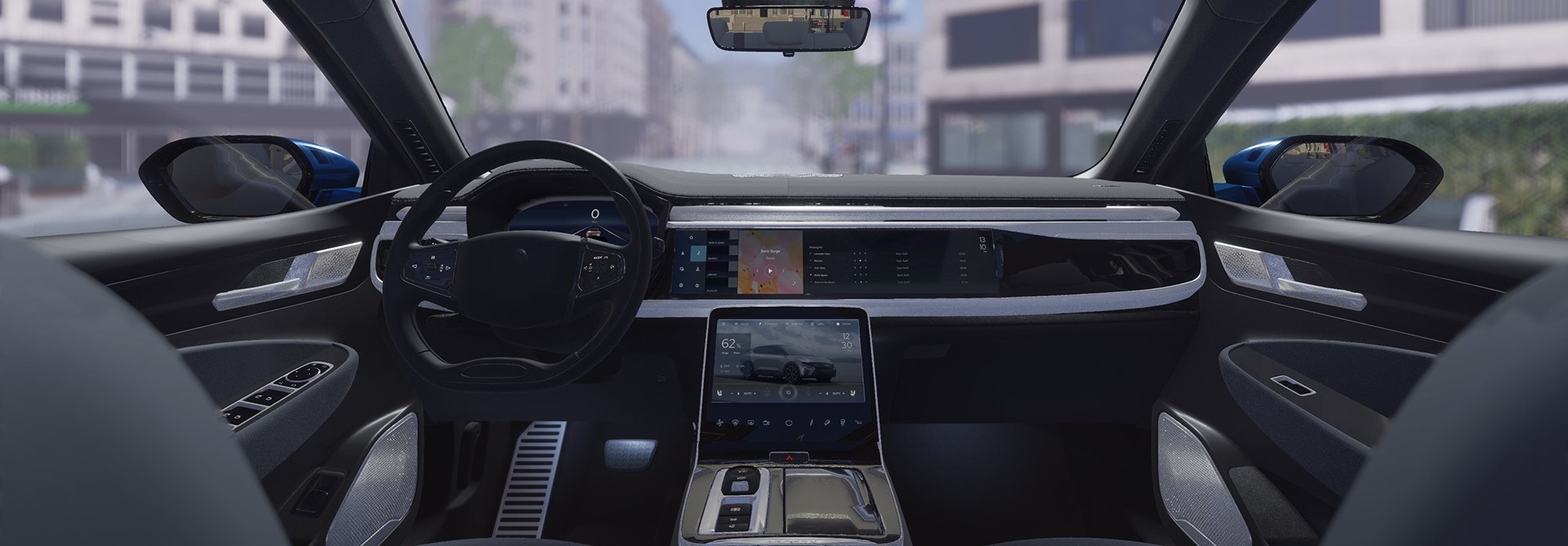
Digital click-dummies—often created using platforms like Figma—simulate interaction paths and allow early-stage feedback from customers and users. Immersive technologies such as Virtual Reality (VR) and Extended Reality (XR) make it possible to test concepts in realistic, virtual vehicle environments. These methods help evaluate usability, ergonomics, and emotional impact long before physical prototypes are built.
User studies provide valuable insights for identifying weaknesses and making data-driven design decisions. The iterative nature of these methods ensures continuous improvement of the user experience.
A detailed insight into the use of innovative technologies such as digital click-dummies, VR, and XR for validating and optimizing UI/UX concepts is provided in the article UI/UX Design in Vehicle Development: How Design Shapes the User Experience
IMPLEMENTATION IN SERIES PRODUCTION AND INTERFACE INTEGRATION
After the validation phase, the design is transitioned into series production. The final UI concept is documented in a comprehensive design and specification package containing all layouts, interaction mechanisms, and technical requirements. Close collaboration with suppliers is essential to ensure smooth integration of interfaces into the vehicle architecture.
Physical demonstrators and virtual models are used to test usability in realistic scenarios and prepare the system for serial release. The goal is to ensure high quality, technical feasibility, and compliance with safety standards.
Further information on transitioning UI/UX designs into series production and supplier collaboration can be found in the article The Importance of UI and UX in the Automotive Industry.
FUTURE TRENDS: VR, XR, AI, LIGHT DESIGN, AND THE EVOLUTION OF VEHICLE INTERACTION
Technologies such as VR and XR enable immersive design and validation processes, reducing development time and costs. Artificial Intelligence (AI) enhances personalization by analyzing driver behavior and adapting the interface accordingly. Augmented Reality (AR) projects navigation cues directly onto the windshield to improve attention and reduce distractions.
Autonomous vehicles are transforming interior design: instead of traditional cockpits, minimalist digital environments focused on comfort and intuitive operation are emerging. Innovative lighting systems that respond to music or driving modes open new design possibilities. These technologies contribute to safer, more emotional, and future-ready in-vehicle interactions.
More insights into upcoming developments in UI/UX can be found in the article The Future of UI/UX Concept Visualization in the Automotive Industry: Innovations, Challenges, and Perspectives.
CONCLUSION
The development of modern automotive UI/UX concepts is a highly complex, interdisciplinary process that combines strategic thinking, creative design, and technological innovation. Advanced tools such as virtual prototypes, immersive VR/XR technologies, and AI-driven personalization enable early testing, optimization, and user-centric refinement of interaction concepts.
Safety, ergonomics, and emotional appeal remain the core priorities to ensure intuitive and trustworthy user experiences. Continuous validation and iterative improvement are essential to meet growing expectations for connectivity, automation, and design quality. Magna plays a key role by providing innovative solutions that shape the future of in-vehicle interaction and contribute to making tomorrow’s mobility safer, smarter, and more emotionally engaging.
Stay connected with Inside Automotive!
You can keep updated with Magna's Inside Automotive through email alerts in real time. Subscribe now!

FAQs - UI/UX Design
Why is UI/UX design so important for modern vehicles?
UI/UX design influences usability, safety, and emotional experience. Intuitive and safe interfaces help reduce distraction and increase user satisfaction—an increasingly critical factor in the automotive sector.
Which technologies are used in the development of vehicle interfaces?
Key technologies include digital prototypes, VR, XR, AI-based personalization, voice and gesture control, and AR. These tools enable early testing, validation, and optimization of interaction concepts.
How does benchmarking support UI/UX development?
Benchmarking helps analyze competitor best practices and compare them with in-house concepts. It provides clear targets—for example in off-road or infotainment design—and contributes to competitive interface development.
What are the main challenges in designing modern in-vehicle interfaces?
Major challenges include increasing system complexity, regulatory compliance, ensuring usability in highly connected environments, and minimizing driver distraction.
How does Magna contribute to innovative automotive UI/UX development?
Magna follows a structured, iterative development strategy, uses immersive VR/XR technologies, and collaborates closely with customers to create functional, safe, and brand-specific interaction concepts.
Which trends shape the future of automotive UI/UX?
Key trends include AR windshield projections, AI-based personalization, autonomous interior concepts, intuitive voice and gesture control, and adaptive lighting systems that enhance the driving experience.
We want to hear from you
Send us your questions, thoughts and inquiries or engage in the conversation on social media.
Related Stories

Inside Automotive - Downloads
Read story
9-min read
How Integrated Sustainability Effectively Supports Development Processes and Why Quality Matters More Than Speed
Read storyStay connected
You can stay connected with Magna News and Stories through email alerts sent to your inbox in real time.