
ClearView mirror showing 3 views: behind the vehicle and both sides which helps with a wider field of vision and reducing blind spots.

Designing Flexible Seating Systems Without Adding Complexity

The industry talks a lot about flexible interiors. In practice, most seating systems aren’t.

Many solutions add configurations, features, and movement without delivering real flexibility at the system level. Instead, they introduce cost, complexity, and mechanical overhead without fundamentally improving how interiors scale across vehicle programs.

For automakers managing tight margins and increasingly complex vehicle platforms, that’s a problem.

The challenge isn’t adding more ways for a seat to move. It’s designing a seating system that can adapt across use cases, markets, and vehicle architectures, without multiplying engineering effort.

That’s a very different definition of flexibility.

The Hidden Cost of ‘More Features’

Over the past decade, seating innovation has followed a familiar path: more adjustability, more comfort features, more specialized configurations.

Individually, these features make sense. Collectively, they create friction.

Each new function introduces additional components, new integration requirements, more validation complexity, and limited reuse across vehicle programs. The result is a system that may appear flexible on the surface, but is rigid underneath—difficult to scale, difficult to standardize, and expensive to adapt.

At the same time, many of these features are rarely used as intended. The industry has historically designed for edge‑case scenarios, while the majority of real‑world usage remains relatively consistent.

This is where the current approach begins to break down.

What Makes a Seating System Truly Flexible?

A truly flexible seating system should reduce complexity—not add to it. That requires a shift from feature‑driven design to system‑level architecture.

Magna’s Flexible Seating System is built around this principle. Instead of layering independent mechanisms, it integrates mechanical design, sensing, and software‑controlled behavior into a coordinated system.

Seat tracks, cushions, rotating bases, and support structures are designed to move together based on defined usage scenarios. This allows multiple configurations to be delivered from a shared hardware foundation, using a building-block approach rather than dedicated mechanisms for each function.

The goal isn’t to offer more features. It’s to get more value out of the same system.

Designing Around Use, Not Possibility

Another common failure point in flexible seating design is over‑indexing on what’s possible rather than what’s actually used.

Concept vehicles often showcase extreme configurations—fully rotating cabins, lounge‑like layouts, or highly specialized modes. While compelling, these ideas rarely translate directly into production environments due to cost, safety requirements, packaging constraints, and customer behavior.

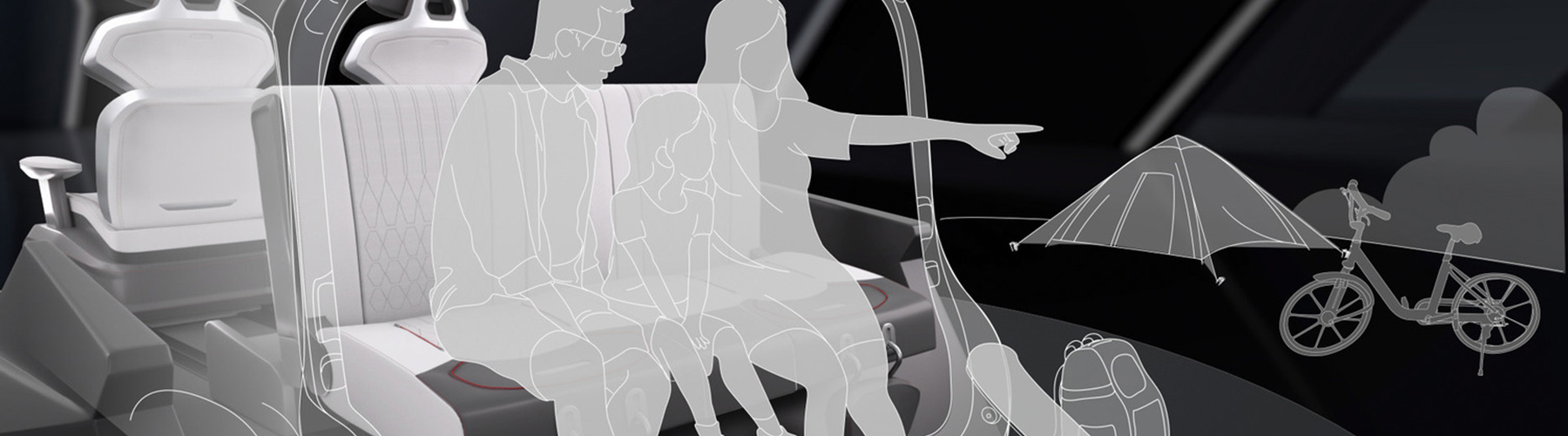
Magna’s approach starts from real usage patterns. The system supports configurations such as:

  • improved ingress and egress through outward seat rotation
  • relaxation positioning that supports a naturally reclined, zero‑gravity‑like posture
  • cargo optimization through compact seat stowage
  • extended flat configurations for rest scenarios

These are not designed as isolated features or novelty modes. They are outputs of a system built on reusable building blocks that can be reconfigured efficiently based on common, repeatable use cases.

The distinction matters—because it helps flexibility stay grounded in value, not demonstration.

A Seating Architecture That Scales

For OEMs, scalability is the real test of any interior innovation.

A solution that works in one vehicle, at one trim level, or in one market is not enough. It must translate across platforms, price points, and regional requirements without driving disproportionate cost or engineering effort.

Magna’s Flexible Seating System is designed as a modular foundation. Core elements such as long travel rails, rotating bases, and adaptive support mechanisms act as building blocks that can be configured differently depending on the application, while maintaining a consistent underlying structure.

This enables:

  • reuse across multiple vehicle programs
  • variation at the software or configuration level rather than hardware redesign
  • faster adaptation to shifting market demands

In this context, flexibility becomes a tool for standardization—not fragmentation.

Rethinking What Flexibility Means

The industry doesn’t need more seating features. It needs systems that make better use of what’s already there.

Flexibility isn’t about how many configurations a seat can achieve. It’s about how efficiently a single seating system can deliver them.

Because in the end, the most valuable flexibility isn’t what the user sees. It’s what the automaker doesn’t have to build twice.

If you’re evaluating how to deliver flexibility without increasing complexity across future vehicle programs, connect with our team to continue the conversation.

Headshot of Daniel Zuo, Senior Innovation Manager, Magna Seating Asia

Daniel Zuo

Daniel Zuo holds a Bachelor’s degree in Mechanical Engineering and Automation from Shanghai DianJi University and brings more than 15 years of experience advancing seating innovation across global automotive programs. At Magna, he collaborates with global engineering and product teams to align real world usage patterns with modular, production ready seating systems.

We want to hear from you

Send us your questions, thoughts and inquiries or engage in the conversation on social media.

Related Stories
If Every Driver is Different, Should Vehicle Safety Systems Respond the Same Way? 

Article

Rethinking ADAS Architecture with High-Performance Centralized Compute

Blog

Inside the Mirror: 5 Integration Challenges Reshaping Driver Safety Systems

Blog

From Features to Systems: Rethinking Vehicle Access

Article

Stay connected

You can stay connected with Magna News and Stories through email alerts sent to your inbox in real time.