4-min read

Autonomous Mobile Robots: Innovating Safer, Efficient Manufacturing Processes
Picture a busy assembly line, bustling with activity. Amidst this carefully orchestrated chaos, sleek, mobile robots glide seamlessly, performing tasks with precision and agility. These are Autonomous Mobile Robots (AMRs), powered by advanced, integrated software, that provide a glimpse into the future of manufacturing.
Much like artificial intelligence (AI), the term “robot” tends to fire up the human imagination about what it would be like to live alongside millions of anthropomorphic, metal-armored assistants.
But the truth is that we’ve been living with and using robots for decades now across many industries, including the automotive sector. The only difference today is that the transformative potential of emerging robotics technologies goes beyond that of previous generations, with more recent models offering opportunities to reshape automotive manufacturing and logistics.
It is important to note that AMRs serve as flexible work tools, enhancing the efficiency of workers by swiftly adapting to various tasks and relieving them from time-consuming material movement activities. This enables workers to focus on higher-value tasks, leading to more enriching work experiences, increased job satisfaction, and reduced turnover.

One prominent trend in the automotive industry today is the use and continuous refinement of AMRs for increasing the safety, efficiency, and cost-effectiveness of the manufacturing lifecycle. And this comes at a time when solving for these issues is paramount for automotive companies looking to navigate a sea of rapid and unprecedented change.
To better grasp the benefits of AMRs, however, it helps to first understand exactly what they are and how they differ from similar technologies used in the industry.
While they vary in form and functionality, AMRs can be defined as robots that move and operate autonomously in any environment, and without being limited to a fixed path. Importantly, this contrasts with Automated Guided Vehicles (AGVs), which perform similar tasks but require supportive infrastructure, such as magnetic strips and floor stickers, to navigate an environment successfully.
The mobility advantage of AMRs over AGVs represents a monumental breakthrough in the application of autonomous robots on the manufacturing floor. AMRs provide greater flexibility to change routes for new layouts and traffic patterns and reduce the need for human interventions when a robot goes off its intended path.
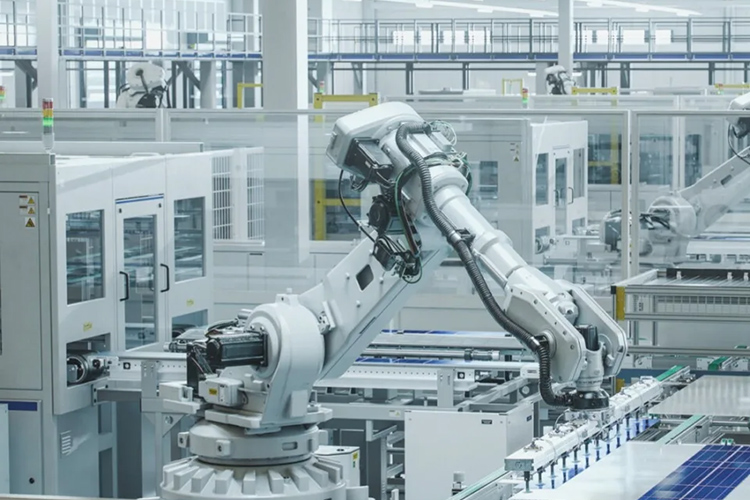
Even though AGVs can automate particularly tedious or dangerous tasks, their use often requires modifications to existing infrastructure, such as wires, tracks, or magnets to guide the robot’s movements. More importantly, changing these paths can be cumbersome if small obstacles are present or if plant floor layouts change. In contrast, as AI becomes increasingly integrated into AMR sensors, their ability to effectively navigate busy, crowded environments becomes infinitely more seamless and intelligent.
Considering these features alone, the benefits of AMRs and integrated software in the automotive manufacturing space are at once far-reaching and transformative. For example, leveraging AMRs on a large scale to handle repetitive tasks provides a clear path to managing costs while bolstering safety and efficiency. Additionally, the use of AMRs in the automotive industry is not limited to manufacturing; it can also apply to the optimization of internal logistics, including enhanced facilities planning, warehouse management, and even in-and-out bound freight.
Overall, despite being relatively new, AMRs are rapidly capturing the attention of manufacturers across sectors. The AMR market is projected to grow at a compound annual growth rate of 18%, reaching a value of over $23 billion by 2028. To put this into perspective, this growth rate far outpaces the average for the broader robotics sector, underscoring the unique value and potential of AMRs.
As we stand on the brink of this new era, AMRs and integrated software for an end-to-end material handling solution will redefine our expectations of what intelligent automation can achieve, shaping the very future of the automotive industry.
We want to hear from you
Send us your questions, thoughts and inquiries or engage in the conversation on social media.
Related Stories
5-min read
5 Technology Shifts Reshaping Vehicle Access
Read story
4-min read
The Real Challenge of Software-Defined Vehicles Isn’t Software
Read storyStay connected
You can stay connected with Magna News and Stories through email alerts sent to your inbox in real time.