
4-min read

The Last 10% of ADAS: Why the Hardest Challenges Still Lie Ahead
Over the past decade, advanced driver assistance systems (ADAS) have moved from niche features to mainstream expectations. Adaptive cruise control, lane centering, automated parking, and traffic jam assist now appear on vehicles across multiple segments, not just luxury flagships.
Progress has been steady, but the next phase will not follow the same curve. As ADAS capabilities improve, each incremental step becomes harder, more expensive, and more complex to validate. The remaining challenge is not adding new features — it is solving the last 10% of real-world scenarios that still prevent systems from operating with consistent confidence.
That last 10% is where the industry’s hardest work still lies.
What the “last 10%” actually means
Most current ADAS platforms perform well in structured, predictable conditions: clear lane markings, moderate traffic, good visibility. The difficulty comes in situations that require judgment under uncertainty.
Consider a few examples:
- A small piece of debris at dusk on an unlit road
- A pedestrian stepping off the curb with unclear intent
- An unmarked construction zone with shifting lane boundaries
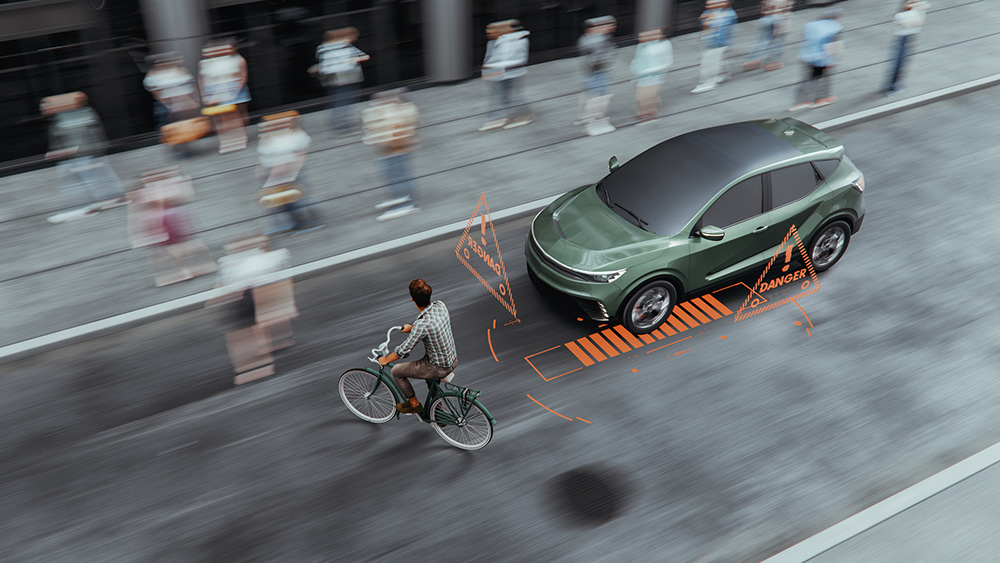
- A cyclist emerging from behind a parked truck
- A stalled vehicle inside a tunnel
These scenarios are difficult not because sensors cannot detect objects, but because the system must interpret context, predict behavior, and make safe decisions with incomplete information. Humans do this instinctively. For automated systems, it remains one of the most complex problems in vehicle engineering.
Improving performance in these cases is not simply a matter of increasing resolution or adding another sensor. It requires a more integrated approach to perception, decision-making, and validation.
More sensors alone won’t close the gap
Today’s ADAS stacks typically combine cameras, radars, and ultrasonic sensors with thermal sensing or lidar used in certain applications. Each modality has strengths and limitations. Cameras provide rich visual detail but struggle in low light. Radars perform well in poor weather but offer less precise classification. Thermal sensing can detect heat signatures beyond headlight range but must be interpreted alongside other data.
Adding sensors can improve coverage, but it also increases system cost, complexity, and data volume. At a certain point, the challenge shifts from sensing more to understanding more.
That is why the focus is moving toward tighter integration across sensing technologies rather than treating each sensor as an independent subsystem. When data from multiple modalities is combined intelligently, the system can maintain confidence even when one input is degraded.
This shift toward earlier and deeper sensor fusion is closely tied to broader changes in vehicle architecture. Centralized compute platforms and higher-bandwidth networks make it possible to process richer data streams and evaluate them together, instead of passing simplified object lists between separate modules. Modern AI- / Machine Learning-based perception and drive policies allow for a more accurate, universal and intelligent interpretation of the driving environment.
The result is a more complete and more intelligent picture of the vehicle environment and traffic scenario — and a better chance of handling the corner cases that still cause disengagements.
The real bottleneck is validation
Even as perception and fusion improve, another constraint becomes more significant: proving that the system is safe enough for production deployment.
Traditional safety frameworks were built around deterministic, rules-based software, where every decision path could be traced and verified. Modern ADAS increasingly relies on machine learning models that interpret complex sensor data and make probabilistic decisions. These approaches can perform better in ambiguous situations, but they are harder to validate using conventional methods.
This creates a gap between what can be demonstrated in controlled conditions and what can be certified for real-world use.
To close that gap, development workflows are shifting toward large-scale virtual testing and simulation. Software-in-the-loop and cloud-based validation environments allow engineers to evaluate thousands of scenarios in parallel, long before hardware is finalized. This makes it possible to identify weaknesses earlier, iterate faster and build the evidence required for regulatory approval.
Without this kind of scalable validation, progress in ADAS will be limited not by sensing performance, but by the ability to prove reliability.
From feature growth to systems thinking
The next phase of ADAS will not be defined by the number of sensors on the vehicle or the length of the feature list. It will be defined by how effectively the entire system works together — sensing, computing, software, and validation — to deliver consistent performance in the situations that are hardest to predict.
Closing the last 10% is less about chasing breakthroughs and more about engineering discipline. It requires architectures that support richer data integration, development processes that scale to massive validation workloads, and a systems-level view of safety from the start of the program.
That is the work that will determine how quickly ADAS moves from controlled, well-defined scenarios to reliable, production-ready capability across the broader market.

We want to hear from you
Send us your questions, thoughts and inquiries or engage in the conversation on social media.
Related Stories
5-min read
ClearView™ Vision System: One Platform, Four Ways to See More
Read story
5-min read
Why AI Success Starts with Business Value and Process Redesign
Read storyStay connected
You can stay connected with Magna News and Stories through email alerts sent to your inbox in real time.