
4-min read
Perfecting the Rectangle: The Challenge Behind EV Battery Enclosures
For more than a decade, automakers have worked to accelerate the mass adoption of electric vehicles (EVs). While consumer preferences and charging infrastructure are often cited as barriers, one of the least understood obstacles is far simpler: manufacturing inefficiency.
Beneath the sleek, futuristic surfaces of today’s EVs are heavy, often imperfectly shaped batteries that must be protected by a precisely sealed enclosure. Yet the traditional process for producing battery enclosures at scale remains time‑consuming, labor‑intensive, and prone to technical challenges.
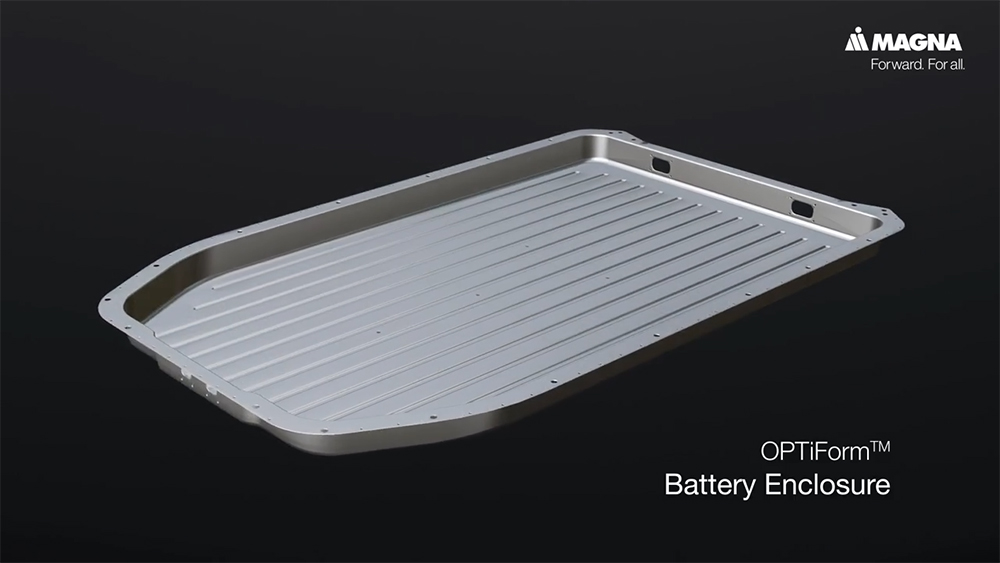
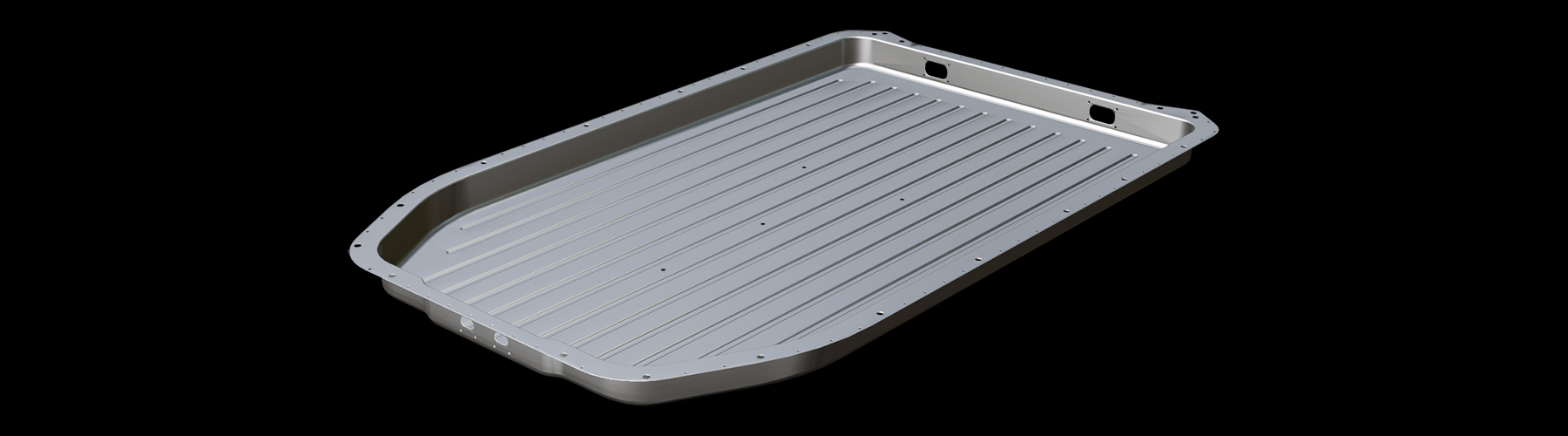
That is changing with Magna’s proprietary OPTiForm Battery Enclosure, a single-component, deep draw design that is reshaping EV manufacturing. OPTiForm mitigates key stamping challenges, improves enclosure quality, and enables scalable, cost-efficient production. Here’s how it addresses one of the industry’s most persistent problems — the “rectangle dilemma.”
The Rectangle Dilemma
To maximize usable volume and integrate cleanly into existing vehicle architectures, EV battery enclosures must be rectangular. This shape supports optimum packaging efficiency, thermal management, and module alignment.
However, conventional metal stamping processes — designed for curved components like roofs, doors, and bumpers — do not naturally produce straight surfaces or tight radii. As a result, OEMs frequently end up with enclosure shapes that resemble bathtubs or include wrinkles, cracks, or sealing risks. These defects can compromise the battery’s protection against environmental hazards.
Manufacturers often compensate with additional pieces, welds and fasteners. While effective, this patchwork approach increases costs, adds weight, complicates quality control, and slows scaling. Over time, these cumulative inefficiencies become significant barriers to EV production.
OPTiForm: A Smarter Manufacturing Solution
Rather than working around the limitations of traditional stamping, Magna engineered a fundamentally better approach. OPTiForm is a simplified, two‑stage deep‑draw stamping process that actively manages metal flow to produce more consistent, one‑piece rectangular enclosures.
OPTiForm embeds intelligence directly into the forming process by:
- Anticipating material behavior using advanced simulation, predictive modeling, and software‑based monitoring;
- Precisely controlling metal flow, decreasing unwanted stretching or wrinkling; and
- Using two defined draw stations to first gather all required material without splitting or wrinkling, then a second draw, which improves consistency and enables straight lines and tight radii.
By managing the root cause — the natural tendency of metal to curve under stress — OPTiForm decreases the need for extensive rework and is aimed at providing superior dimensional accuracy.
Efficiency, Performance, and Design Benefits
OPTiForm delivers measurable improvements across manufacturing and vehicle performance:
- Removes hundreds of welds and fasteners typically required for traditional multi-piece enclosures;
- Reduces production steps, cutting cost, labor, and time;
- Unlocks up to 10% more internal volume, enabling greater range or more compact vehicle architectures;
- Supports scalable mass production across multiple vehicle segments; and
- Enhances design flexibility for future EV platforms.
Importantly, this breakthrough didn’t come from exotic materials or entirely new chemistries. It emerged from Magna’s cross-disciplinary collaboration among manufacturing, engineering, tooling, and simulation teams — proving that process innovation alone can overcome long-standing physical limitations.
Moving EVs Forward, One Rectangle at a Time
OPTiForm represents a major advancement in EV battery enclosure technology and a critical step toward more efficient, scalable EV manufacturing. By solving the rectangle dilemma, Magna is helping OEMs globally with EV adoption and unlocking new opportunities for innovation.
Interested in learning more about OPTiForm battery packs, as well as how this innovative stamping strategy can benefit your EV manufacturing and design processes? Reach out to a Magna specialist today.

We want to hear from you
Send us your questions, thoughts and inquiries or engage in the conversation on social media.
Related Stories

5-min read
ClearView™ Vision System: One Platform, Four Ways to See More
Read story
5-min read
Why AI Success Starts with Business Value and Process Redesign
Read storyStay connected
You can stay connected with Magna News and Stories through email alerts sent to your inbox in real time.