5-min read

The Next Leap in Vehicle Safety: V2X and Real-time Data Sharing
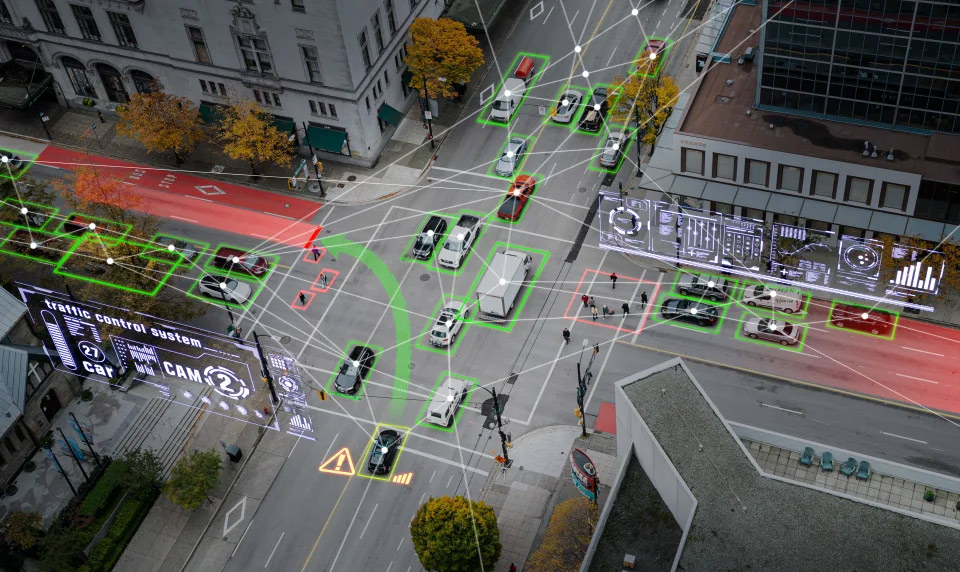
Driving often feels like a solo activity, but staying safe on the road often depends on working together with the road users all around us. Every day, countless collisions are avoided thanks to simple cooperative cues—like flashing turn signals, hinting vehicle placement or a quick glance between drivers.
But in situations where visibility is limited—such as blind intersections or sharp curves—those cues aren’t always possible. When we can’t see or predict what another vehicle is doing, our ability to respond safely is compromised. In those moments, wouldn’t it be safer if our cars could communicate for us?

This is the promise of vehicle-to-everything (V2X) technology: a future of mobility defined by constant connectivity and shared awareness, where cooperative driving is no longer a personal choice but a built-in feature of every vehicle.
V2X extends the capabilities of advanced driver assistance systems (ADAS) and autonomous driving by enabling real-time communication between road users and infrastructure. It’s powered by data from existing in-vehicle technologies—like cameras, radar, LiDAR and AI—and transforms them into a network of shared intelligence.
Real-World Applications of V2X
V2X is mature enough to be used at a limited scale to alert drivers about road hazards, traffic congestion, construction zones, and emergency vehicles. As the technology evolves, it could enable features like cooperative adaptive cruise control (ACC), where vehicles automatically adjust speed based on the movement of others nearby. It also lays the groundwork for intelligent ADAS systems that enhance safety in autonomous vehicles.
A Scenario in Action
Imagine driving on a busy, narrow road. Suddenly, something feels off as vehicles behind you begin pulling to the side. You glance again and spot an ambulance rapidly approaching, so you also make room.
Now, leap forward in time to the same scenario, but you're enjoying the comfort of an autonomous vehicle. Thanks to the emergency vehicle sharing its movement data, your vehicle understands it is time to act well before onboard sensors can detect the situation. It alerts you about the unusual maneuver it is about to perform. Once the ambulance passes safely, the vehicle returns to normal operation.
Driving environments are highly dynamic, and autonomous vehicles face many challenges. Communication between road users helps create a collaborative environment that is essential for road safety and capable of handling unexpected situations like roadwork or emergency vehicles.
Challenges to Overcome
To unlock the full potential of V2X, the mobility industry must overcome several challenges. Uncertainty of regulations and the plurality of communication standards stand in the way of widespread adoption of V2X without barriers. Trustworthy data is essential.
The spectrum for direct communication is limited and must be used wisely. On one hand, running multiple non-compatible communication technologies in the same very limited frequency band creates interference situations and doesn’t promote collaboration. On the other hand, as communication technology evolves, there must be a way to roll out new generations, especially if it’s outperforming the previous generation.
Communication can also help overcome challenges in other systems such as positioning or sensing by joining forces between the different systems.
Why It Matters
These hurdles are significant—but they’re not insurmountable. With urgency and collaboration across engineering, regulatory and industry leaders, V2X can become a foundational element of safer, smarter mobility.
From Magna’s perspective, the opportunity to dramatically improve vehicle safety, performance and user experience makes V2X a goal worth pursuing.
We want to hear from you
Send us your questions, thoughts and inquiries or engage in the conversation on social media.
Related Stories
4-min read
The Real Challenge of Software-Defined Vehicles Isn’t Software
Read story
5-min read
ClearView™ Vision System: One Platform, Four Ways to See More
Read storyStay connected
You can stay connected with Magna News and Stories through email alerts sent to your inbox in real time.